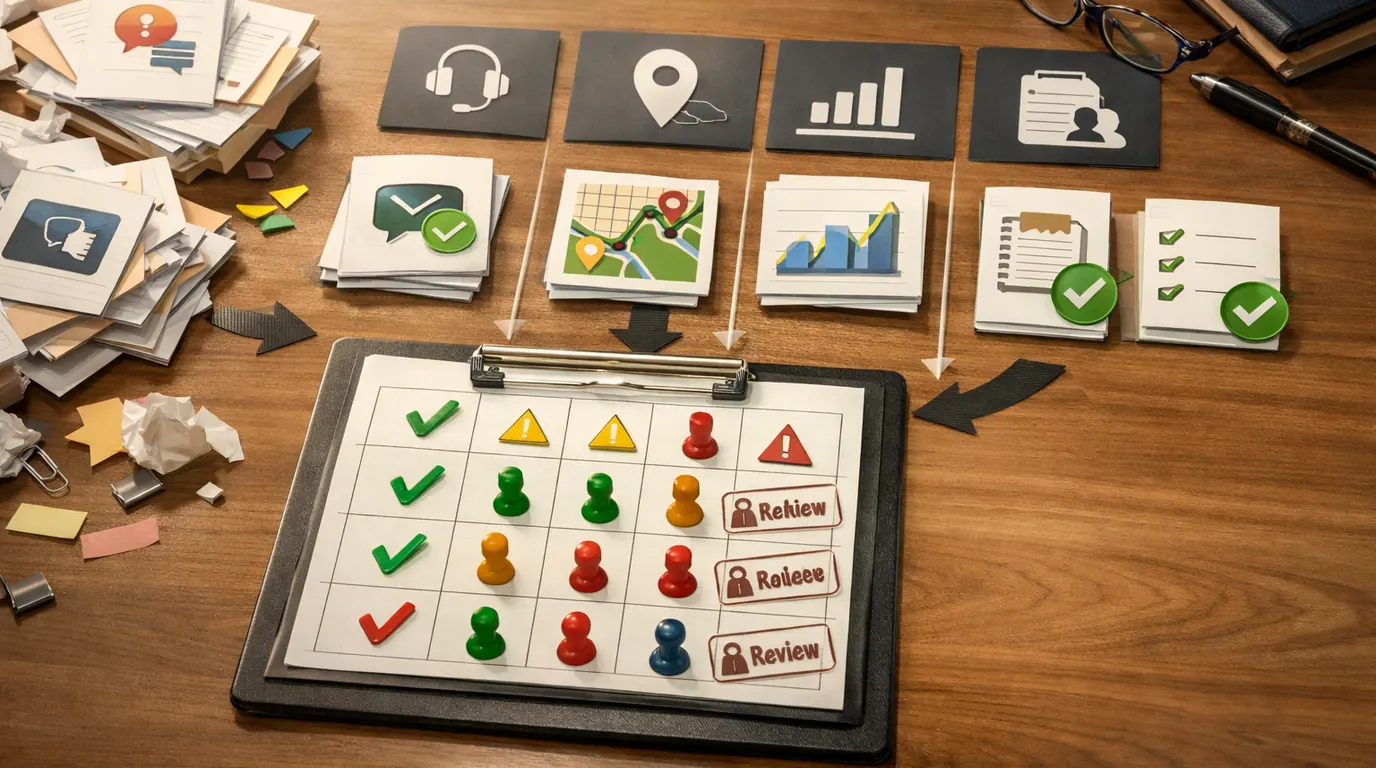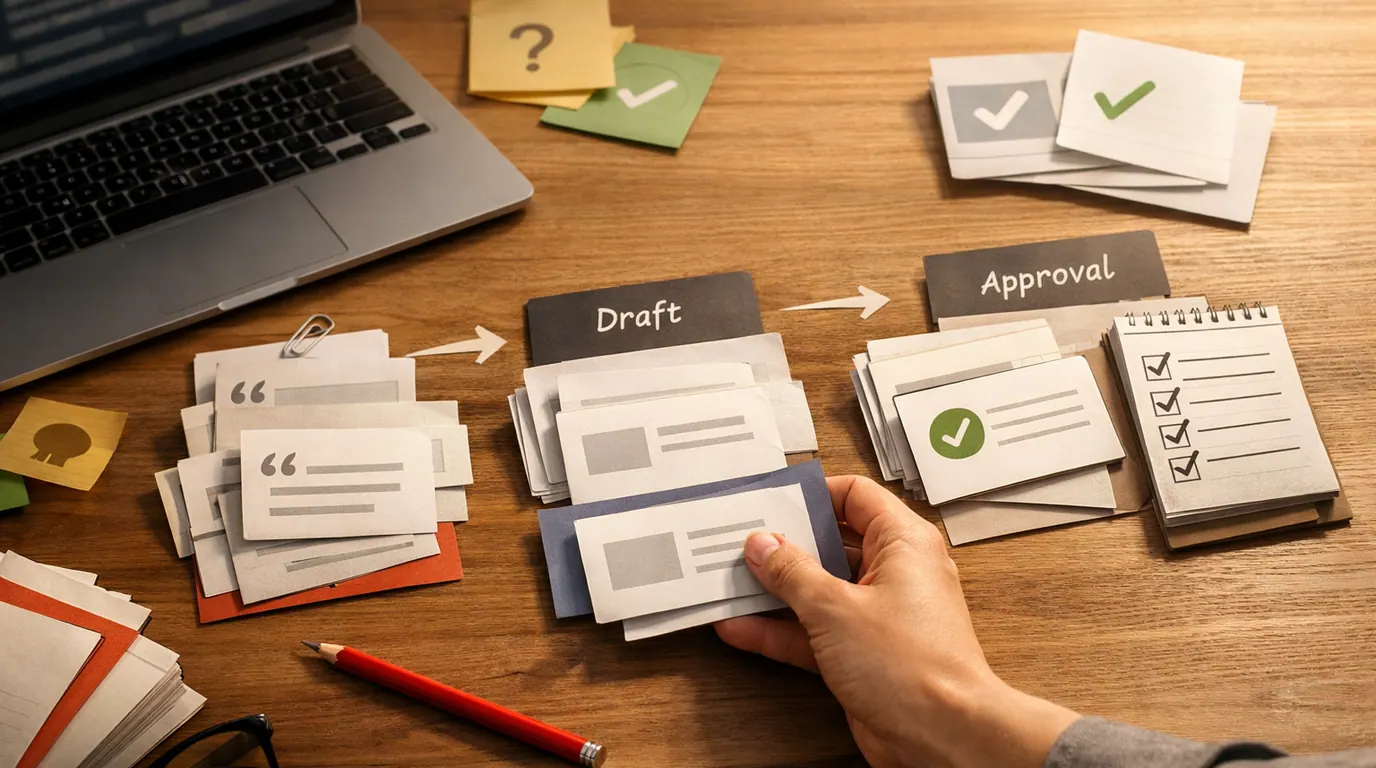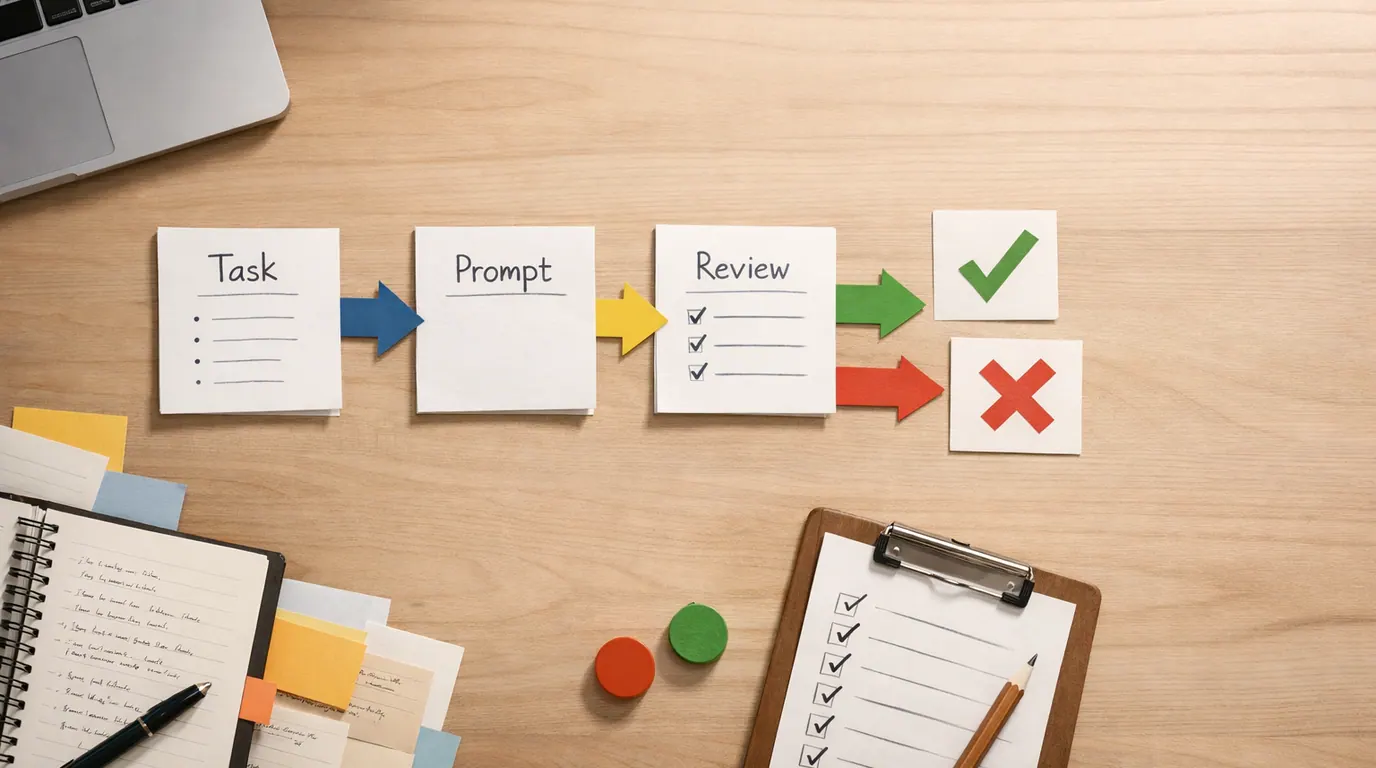
If you searched for “how to use ai for marketing,” the useful answer is not “let a chatbot run your campaigns.” The useful answer is a repeatable way to use AI for research, audience insight, content planning, ad variations, email testing, analytics summaries, social repurposing, and workflow automation without letting the tool become the strategist.
How to use AI for marketing comes down to this: give the system real context, ask it to prepare something reviewable, and make a human approve anything that affects customers, budget, claims, or brand trust. The best how to use AI for marketing advice is intentionally unglamorous: start with one bottleneck where the output can be checked quickly.
This how to use AI for marketing guide is written for marketers, founders, and small teams that want a practical next step. AI in marketing can speed up messy work, but it works best when it turns raw material into a decision artifact instead of pretending to be the decision-maker.
Pick research, briefs, copy variants, reporting, social repurposing, lead routing, or campaign QA before changing the whole stack.
Use customer language, product notes, analytics exports, past campaigns, channel constraints, and approval rules.
People still own positioning, proof, privacy, brand voice, compliance, budget, and final publish decisions.
Start With a Low-Risk Marketing Job
AI marketing is the use of AI systems to help with marketing research, planning, content, personalization, analytics, and automation. IBM’s guide to AI in marketing and Amazon Ads’ AI marketing overview both frame the value around better segmentation, personalization, predictive analysis, creative support, and campaign optimization.
That does not mean every marketing decision should become automated. If you are still learning how to use AI, choose work that is frequent, bounded, and easy to inspect. A good first use case has clear inputs, a visible output, and a human owner.
Use AI when the job looks like this:
- Research is scattered: summarize survey responses, sales notes, support tickets, or reviews into themes a marketer can verify.
- Ideas need range: brainstorm campaign angles, hooks, subject lines, objections, and creative routes before the team chooses.
- Copy needs variants: draft multiple ad, email, landing page, or social versions for testing and editing.
- Reports need clarity: turn campaign data and notes into plain-English findings, questions, and next actions.
- Workflow is repetitive: classify inbound leads, route requests, create content briefs, or summarize meeting notes for follow-up.
Avoid starting with the most sensitive work: customer-facing claims in regulated industries, private customer data, final positioning, pricing decisions, legal review, crisis responses, or fully automated outreach at scale.
The Practical AI Marketing Workflow
A strong AI marketing workflow ends with a decision artifact: a brief, shortlist, table, draft, test plan, or report a person can inspect.
Use this how to use AI for marketing workflow when you want a repeatable process instead of a one-off chat:
- Name the marketing decision. Decide whether you need a campaign angle, audience insight, content brief, copy variant, report summary, or routing recommendation.
- Attach real inputs. Provide product facts, audience notes, customer language, analytics context, examples of approved voice, and channel constraints.
- Ask for options, not a final answer. Request alternatives with tradeoffs, assumptions, risks, and the reason each option might work.
- Force a review step. Ask the model to flag unsupported claims, missing data, vague language, privacy risks, and places where a human must decide.
- Save the reusable pattern. Turn the best prompt, inputs, and approval checklist into a template the team can use again.
| Marketing job | Use AI for | Useful artifact | Human check |
|---|---|---|---|
| Customer research | Group reviews, survey answers, call notes, and support tickets into themes | Theme map with evidence snippets | Confirm the sample is real and not overgeneralized |
| Content planning | Cluster topics, draft briefs, find missing questions, and suggest internal links | Content brief or editorial calendar | Verify search intent, expertise, claims, and originality |
| Email marketing | Generate subject lines, preview text, segments, and follow-up variations | Testable email variants | Check offer accuracy, consent, tone, and list rules |
| Paid ads | Create message angles, short copy variants, objections, and landing page hypotheses | Ad test matrix | Review claims, compliance, targeting, and budget logic |
| Social media | Repurpose long content, adapt posts by platform, summarize comments, and draft replies | Platform-specific post batch | Approve tone, context, links, visual rights, and replies |
| Analytics | Summarize trends, anomalies, funnel changes, and questions for the next test | Campaign readout | Check source data, attribution limits, and business context |
For deeper channel-specific work, use our guides to AI for SEO, ChatGPT prompts for marketing, AI for lead generation, and AI workflow automation. The pattern is the same: AI prepares the work; people approve the judgment.
How to Use AI for Marketing Examples by Channel
Use this how to use AI for marketing examples section as a menu, not a mandate. Pick the row that matches your current bottleneck and run a small test before adding more tools or automation.
| Channel | Practical AI task | Example prompt direction | What to inspect |
|---|---|---|---|
| SEO and content | Turn keyword, customer, and product notes into a brief. | Group these notes by search intent, unanswered questions, and proof needed. | Expertise, source quality, internal links, and whether the draft adds something new. |
| Create subject line and body variants for one segment. | Write six subject lines for this audience, each using a different buying trigger. | Consent, offer accuracy, claims, personalization, and deliverability risks. | |
| Paid ads | Develop message angles and objections for an A/B test. | Make a test matrix with pain-led, proof-led, urgency-led, and comparison-led angles. | Policy fit, landing page match, proof, budget, and whether the test can teach you anything. |
| Social media | Repurpose a webinar, article, or report into platform-specific posts. | Adapt this source into LinkedIn, X, newsletter, and short video post ideas. | Platform tone, originality, visual rights, comments, and whether the post sounds human. |
| Lead generation | Summarize inbound context and suggest routing rules. | Classify these demo requests by fit, urgency, likely use case, and next action. | Data quality, bias, handoff owner, privacy, and whether the lead score is explainable. |
| Reporting | Translate performance notes into a campaign readout. | Summarize what changed, what might explain it, what is uncertain, and what to test next. | Attribution limits, missing context, cherry-picked metrics, and false certainty. |
If social is the blocked workflow, compare the tool categories in our AI tools for social media shortlist. If the blocker is prompt quality, the reusable structure in our guide to writing better AI prompts applies directly to marketing briefs.
Build Strategy Without Letting AI Become the Strategist
If your real question is how to use AI for marketing strategy, start by separating evidence from opinion. AI can summarize customer data, compare positioning options, identify campaign risks, and draft a go-to-market plan. It cannot know your real market, margins, constraints, sales reality, or customer relationships unless you provide that evidence and inspect the result.
Use AI to prepare strategy inputs:
- Audience segments: ask for needs, objections, triggers, evidence, and messages by segment.
- Positioning options: ask for three credible angles, each with proof needed and likely objections.
- Campaign priorities: ask for a tradeoff table across reach, urgency, cost, risk, and sales handoff.
- Channel fit: ask which channels match the buyer behavior you actually see, not the channels everyone mentions.
- Learning plan: ask what the campaign should teach you in two weeks, not only what it should publish.
Then make the human decision explicit. Who owns the target customer? Who approves the promise? Who confirms that the proof is real? Who decides whether the budget is worth the expected learning? AI can speed up the prep, but strategy still requires judgment and accountability.
Prompts and Inputs That Make Output Less Generic
Generic output usually comes from generic input. If you ask for “a marketing campaign,” the model has to invent the audience, offer, proof, channel, tone, and constraints. A better prompt reads like a small creative brief.
Use this prompt frame when you need a draft, brief, report, or campaign option:
Act as a marketing assistant preparing work for human review. Business: [what we sell]. Audience: [segment and pain]. Offer: [specific offer]. Channel: [email, ad, social, landing page, webinar, SEO, or sales enablement]. Source material: [approved facts, customer language, analytics notes, examples]. Constraints: [tone, length, claims, privacy, compliance, deadline]. Output: [table, brief, draft, variants, report, checklist]. Review rule: flag assumptions, unsupported claims, weak evidence, privacy risks, and decisions a human must make.
Reusable AI marketing prompt frame
The difference is not prompt magic. The difference is context. Strong prompts tell AI what is true, what is uncertain, what the output should look like, and what it must not decide. That is the practical answer to how to use AI in a marketing team without turning every project into a pile of disconnected chats.
When the output still sounds flat, ask for a critique before asking for a rewrite:
- Mark vague claims. Ask AI to highlight lines that could apply to any competitor.
- Find missing proof. Ask what evidence a skeptical buyer would need before believing the promise.
- Compare tone. Paste two approved examples and ask what the draft does differently.
- Reduce edit distance. Ask for three rewrites: plain, sharper, and more specific, then choose manually.
What to Review Before Anything Goes Live
AI-assisted marketing still needs editorial discipline. UW Professional and Continuing Education’s AI task guide gives a practical warning to vet AI-created text and images for accuracy, bias, copyright, and trademark issues before publishing. That same caution applies to campaigns, reports, and automations.
Works Well When
- Use AI for repetitive work where a person can quickly inspect the output.
- Use AI to compare options, summarize source material, and create draft variants.
- Use AI to make review easier by asking for assumptions, risks, and missing proof.
Watch Out For
- Do not let AI invent customer evidence, statistics, testimonials, case studies, or product capabilities.
- Do not paste private data into unapproved tools or connect systems without security review.
- Do not automate replies, targeting, pricing, sensitive decisions, or public claims without a named human owner.
Before publishing or automating, check:
Do
- Verify facts, customer claims, links, offers, and product details.
- Compare the output against real customer language and approved brand voice.
- Keep a review trail for campaigns, reports, automations, and high-risk messages.
- Use anonymized or approved data when privacy is unclear.
Do not
- Publish AI copy you have not read closely.
- Let generated replies handle angry customers, refunds, legal issues, or sensitive accounts alone.
- Treat AI analytics summaries as truth without checking the underlying data.
- Assume a tool’s output is compliant just because it sounds professional.
If privacy is a recurring concern, read our AI privacy concerns guide before connecting customer records, transcripts, CRM data, ad accounts, or internal reports to any AI workflow.
A 14-Day How to Use AI for Marketing Checklist
This how to use AI for marketing checklist gives you a small rollout instead of a vague ambition. The goal is not to adopt every possible AI tool. The goal is to prove that one marketing workflow becomes clearer, faster, or easier to review.
Pick one workflow: content briefs, email variants, ad testing, social repurposing, customer feedback, lead routing, or reporting.
Gather product facts, audience notes, campaign examples, analytics context, source material, and data boundaries.
Ask for options, critique, and revision. Track which prompt produces the most useful reviewable artifact.
List what a human must approve: claims, tone, privacy, data, compliance, targeting, budget, and final publish.
Use the AI-assisted output in a narrow campaign, email, report, or content task with normal approval.
Compare cycle time, edit distance, review failures, team adoption, and whether the workflow produced better decisions.
If the test works, turn it into a reusable team asset: prompt template, input checklist, output standard, approval rule, and owner. If it does not work, narrow the job before adding another tool.
The Bottom Line
AI helps marketing most when it prepares useful work for people who know the customer. Start with a low-risk bottleneck, bring real context, ask for options and critique, and keep human review visible.
Use AI to research, organize, draft, compare, summarize, and test. Keep people responsible for positioning, evidence, brand trust, privacy, and final decisions. That is slower than pretending the tool can run marketing by itself, but it is much more likely to produce work a real customer will believe.
Frequently asked questions
What is AI in marketing?
AI in marketing means using machine learning, generative AI, predictive analytics, or automation to support marketing work such as audience research, segmentation, content drafts, campaign testing, personalization, reporting, and routing. The useful version improves a specific workflow while keeping a person accountable for the decision.
What should marketers use AI for first?
Start with a low-risk, reviewable task that already repeats: summarizing customer feedback, clustering content ideas, drafting email subject lines, creating ad variations, repurposing a webinar, or turning analytics notes into questions. Avoid making AI responsible for positioning, legal claims, sensitive data, or final publishing decisions on day one.
Can AI write marketing copy for me?
AI can produce useful first drafts, alternate angles, headlines, social captions, email options, and landing page sections. It should not be the final voice of the brand by itself. Strong marketers add customer insight, proof, specificity, channel judgment, source checks, and edits that remove generic or unsupported claims.
How do I use AI for marketing strategy?
Use AI to organize evidence, compare audience segments, surface assumptions, draft campaign options, and stress-test tradeoffs. Keep the strategic calls with humans: who the customer is, what promise is credible, which channel deserves budget, what proof is safe to use, and which results actually matter to the business.
What marketing data is safe to put into AI tools?
Use anonymized, approved, or public inputs unless your company has cleared the tool for private data. Do not paste customer records, unreleased financials, contracts, employee data, regulated information, or confidential campaign exports into an unapproved AI system. Ask legal, security, or IT before connecting sensitive sources.
How do I know if AI is improving my marketing workflow?
Measure the workflow, not the novelty. Track edit distance, cycle time, number of useful variants, review failures, factual corrections, approvals, campaign learning, and whether the team reuses the prompt or automation after the first week. If AI creates more cleanup, inconsistency, or risk, narrow the job.