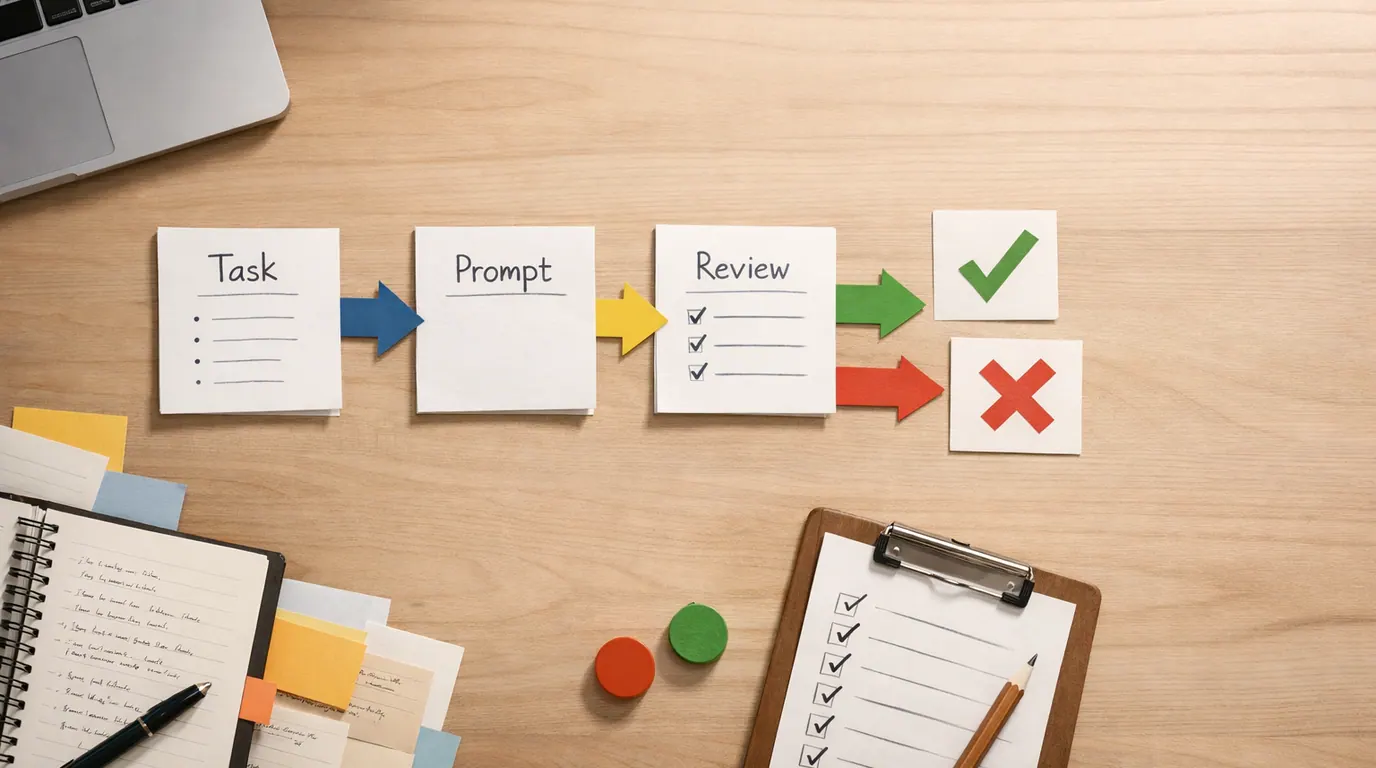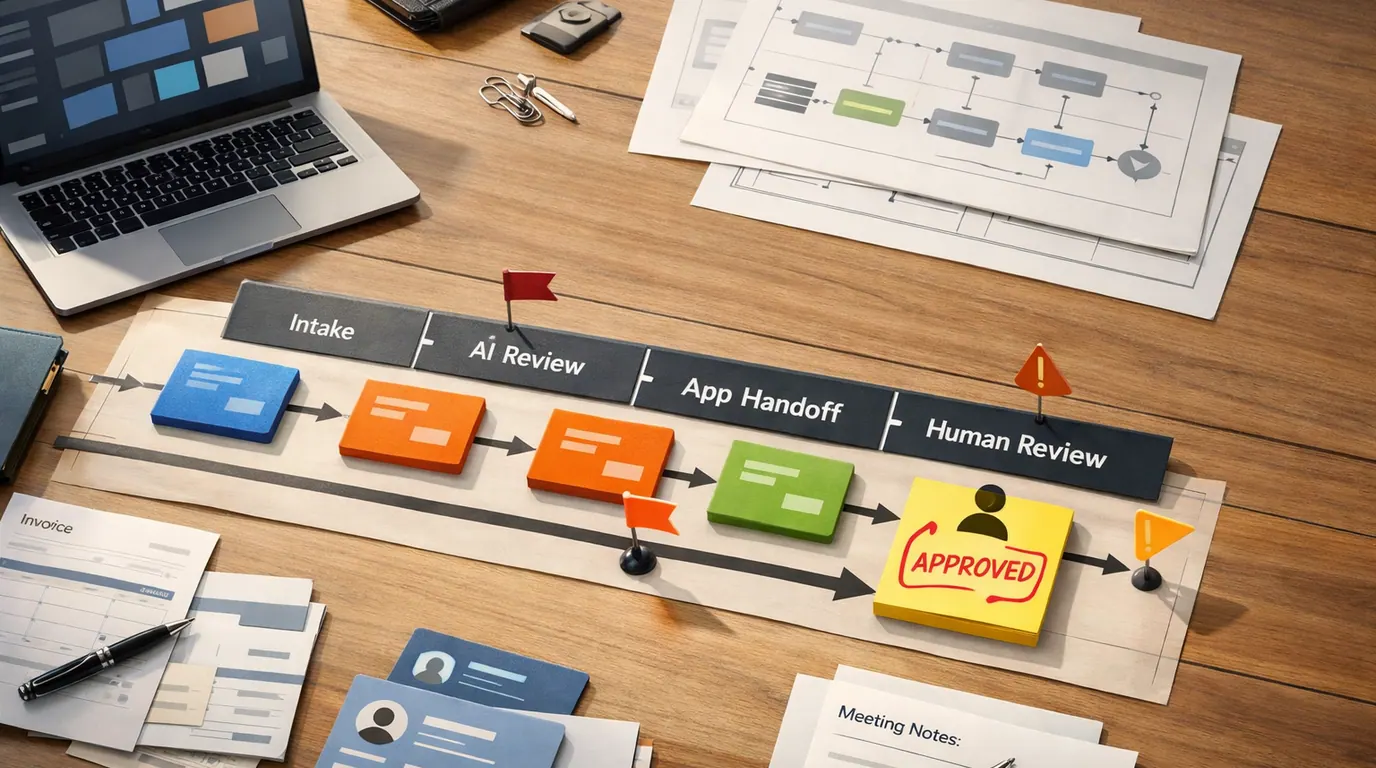
If you searched for “ai automation for business”, the useful answer is not “buy an AI platform and automate everything.” The useful answer is a way to choose one repeated workflow, decide which part needs AI judgment, connect the right systems, and keep people responsible for the moments that carry risk.
AI automation is strongest when regular automation gets stuck: messy emails, inconsistent PDFs, long call notes, open-ended support tickets, unlabeled leads, or weekly reporting comments that do not fit clean if-this-then-that rules. It is weakest when the business gives AI broad authority before the process is understood.
Use this AI automation for business guide as an operating playbook. It gives you a shortlist by job, concrete use cases, a workflow template, a checklist, and the review rules that keep automation useful instead of brittle.
Pick a repeated handoff where work already enters through email, forms, chat, CRM, tickets, files, meetings, or spreadsheets.
The AI should create a summary, classification, field extraction, draft, route, forecast, or task a person can inspect.
Keep humans on exceptions, customer promises, payments, legal exposure, employee decisions, permissions, and private data.
What AI Automation for Business Means
AI automation for business combines workflow automation with AI tasks such as reading, classifying, summarizing, extracting, drafting, predicting, or recommending. Traditional automation can move a form response into a CRM. AI automation can also read the message, infer the request type, extract missing fields, summarize the account context, and prepare a follow-up for review.
That does not mean every workflow should become autonomous. Most businesses get better results in the middle: predictable automation handles triggers, app handoffs, records, alerts, and approvals, while AI handles the messy interpretation step. A person still owns the customer promise, the source-of-record change, and the exception.
The quiet test is whether a teammate can explain one run without opening six admin screens. If the team cannot tell what triggered, what AI read, what it decided, what changed, and who reviewed it, the automation is not ready for scale.
Quick Picks: Best AI Automation for Business by Job
There is no single best AI automation for business because the right choice depends on the workflow, systems, data sensitivity, and owner. Start with the job, then evaluate products against integration depth, visibility, review controls, and total operating effort.
| Pick | Best for | Why it fits | Limit | Pricing/free-plan note |
|---|---|---|---|---|
| Zapier | Broad no-code handoffs across forms, email, spreadsheets, CRM, chat, docs, and AI steps | A practical first stop when a team needs many app connections and wants AI to classify, summarize, draft, or route before the next action. | Complex branching, sensitive data, and high-volume workflows still need owners, logs, permission reviews, and cleanup rules. | Check current vendor pricing, task limits, AI features, app restrictions, and team controls before relying on it. |
| Make | Visual workflow building, multi-step scenarios, routers, AI prompts, and app-to-app automation maps | Make fits teams that want to see how data moves through an AI automation for business workflow and adjust branches without heavy code. | Visual canvases can become hard to maintain if naming, failure alerts, and ownership are weak. | Check current operation limits, AI usage, free-plan terms, teams, and enterprise controls. |
| n8n | Technical teams that want low-code speed, custom logic, APIs, self-hosting options, and deeper workflow control | n8n is useful when the process needs code fallback, custom systems, human-in-the-loop steps, or tighter control than basic no-code builders. | It needs technical stewardship. A business team without a maintainer can build flows that nobody can debug later. | Check current cloud pricing, self-hosting responsibility, support, security needs, and enterprise features. |
| Microsoft Copilot and Power Automate | Microsoft 365, Teams, Outlook, SharePoint, Dynamics, approvals, and governed enterprise workflows | This stack fits companies already operating inside Microsoft identity, documents, meetings, and approval systems. | It may be heavier than a small team needs if the workflow only connects a few non-Microsoft apps. | Check current Microsoft licensing, connector tiers, AI features, admin settings, and tenant controls. |
| HubSpot, Zendesk, or Salesforce | CRM, marketing, sales, service, support routing, customer records, and department-specific automation | These fit when the automation should live near the customer record rather than in a separate workflow builder. | Native automation can be less flexible outside its own ecosystem, and customer-facing drafts need review. | Check current plan requirements, AI packaging, data terms, integration limits, and add-on costs. |
| Moveworks or Domo | Larger organizations that need employee-service automation, enterprise workflow orchestration, analytics-triggered action, or cross-system governance | These fit teams that need automation tied to enterprise knowledge, shared business data, and measurable operational processes. | Evaluation, implementation, and change management are heavier than a small no-code pilot. | Check current vendor pricing, contracts, security review, implementation effort, and cancellation or migration risk. |
This is a shortlist, not a live benchmark. The research packet supports product categories and common use cases, but it does not support exact current prices or hands-on test scores. Treat vendor pricing, free-plan limits, data terms, and feature packaging as items to verify during procurement.
How We Chose the Shortlist
This article uses the supplied research brief, the SERP patterns around “AI automation for business”, and the common tool categories surfaced in the brief: no-code automation, visual workflow builders, CRM and support automation, enterprise orchestration, and analytics-triggered workflow platforms. It does not claim hands-on testing, live pricing verification, benchmark scoring, or legal review.
The selection criteria are practical:
- Workflow fit: does the tool own the handoff you actually need, such as intake, triage, routing, drafting, reporting, or approval?
- Integration fit: does it connect to the systems where the work already lives, not just a demo spreadsheet?
- AI fit: does the AI step produce something inspectable, such as extracted fields, a summary, a classification, a draft, or a recommendation?
- Control fit: can the team see run history, permissions, failure paths, retries, human approvals, and source-of-record changes?
- Operating fit: can the people who will own the workflow maintain prompts, mappings, alerts, and exceptions after launch?
If your first question is “Which platform is most powerful?”, slow down. The more useful question is “Which platform lets the right owner understand and improve this workflow every week?”
AI Automation for Business Use Cases to Start With
The best early AI automation for business use cases are frequent, inspectable, and reversible. They save time without giving AI final authority over sensitive outcomes.
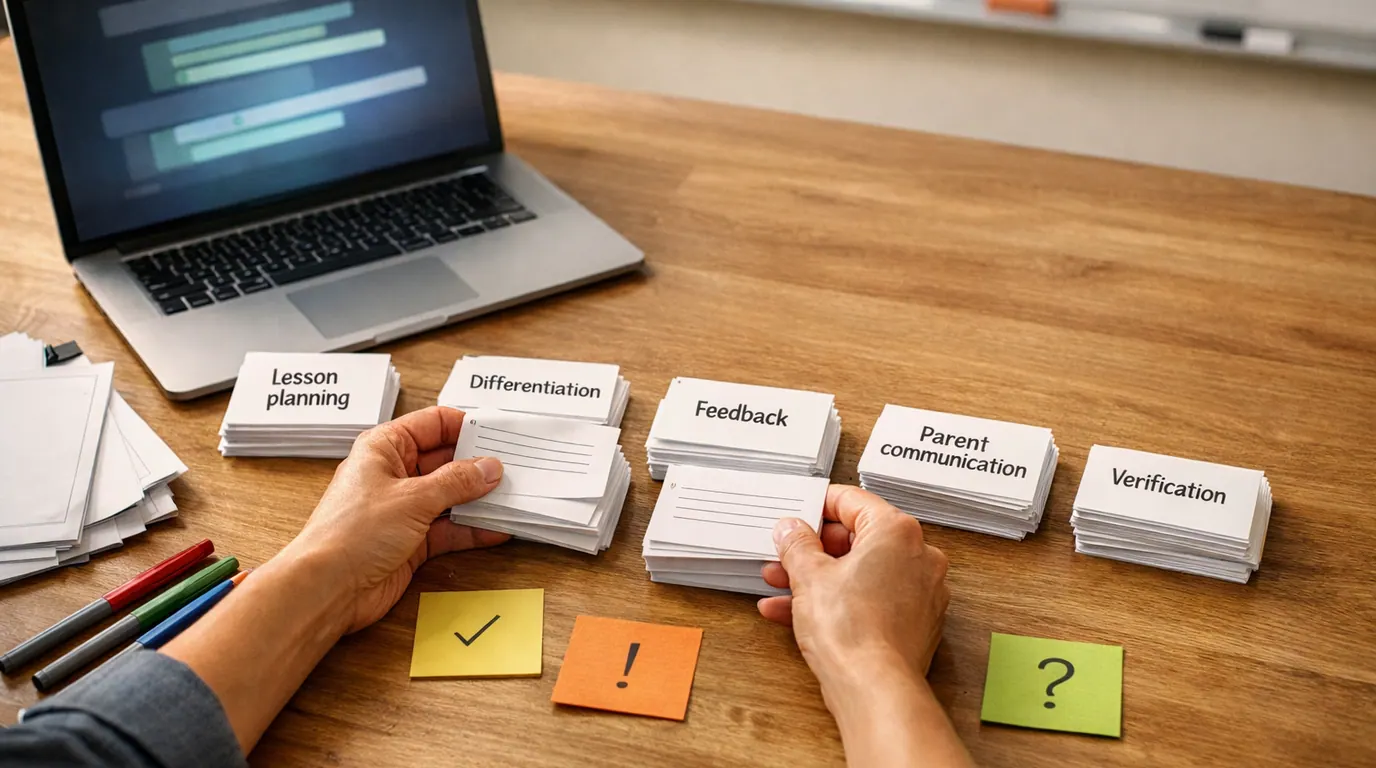
Use these AI automation for business examples as patterns, not prescriptions. The same shape appears across departments: collect messy input, let AI prepare a structured handoff, then ask the accountable person to approve anything risky.
| Use case | Input | AI step | Automation action | Human review |
|---|---|---|---|---|
| Lead intake | Demo form, inbound email, website chat, or event list | Summarize company fit, extract missing fields, classify segment, and draft follow-up | Create CRM task, route to owner, and prepare a reply | Sales checks consent, territory, claims, and qualification before outreach. For the wider funnel, see [AI for Lead Generation](/blog/ai-for-lead-generation/). |
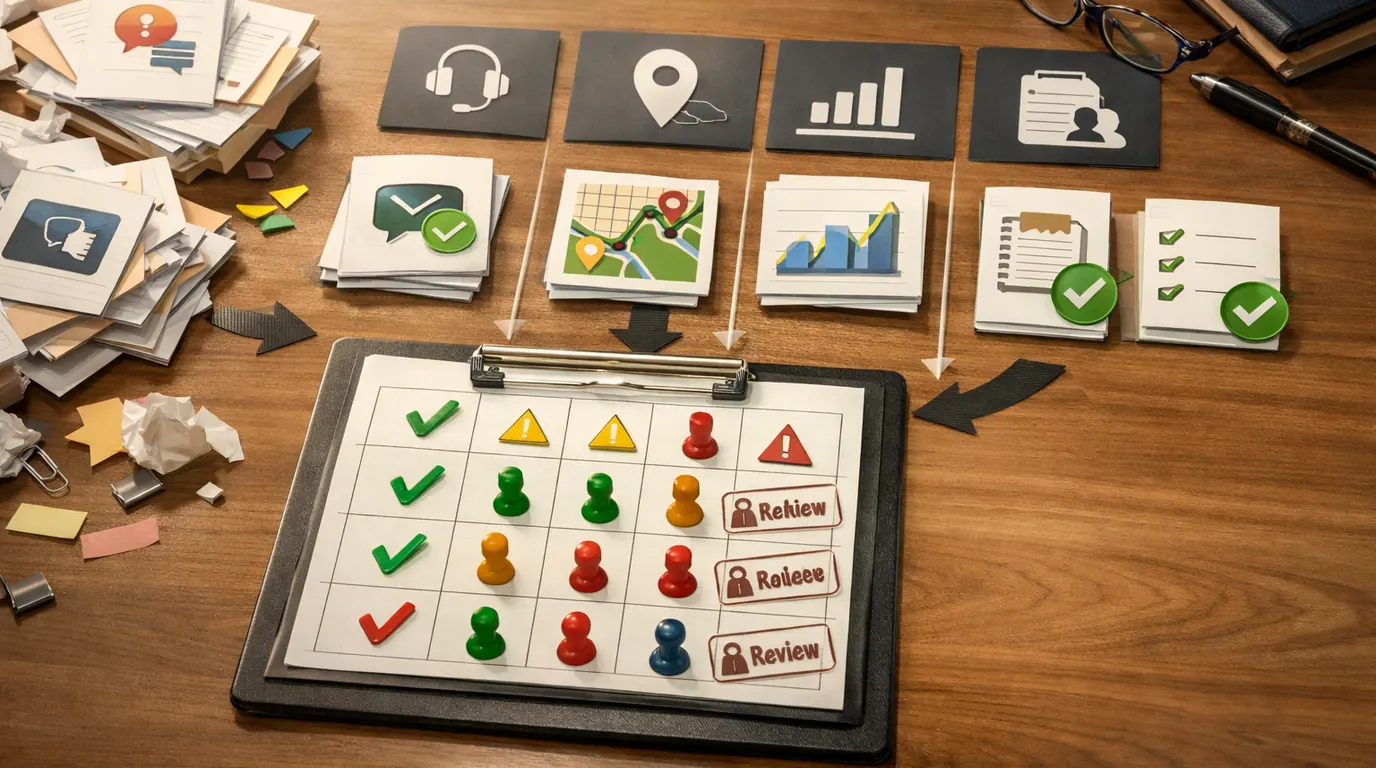
| Support triage | Customer ticket, chat transcript, screenshot, or help-center search | Classify issue type, urgency, sentiment, product area, and likely knowledge-base article | Route ticket, attach summary, suggest response, and flag escalation | Support approves customer-facing messages and handles refunds, security issues, or angry customers. |
| Invoice or document intake | PDF invoice, contract request, form upload, or vendor email | Extract fields, spot missing information, classify exception, and summarize context | Update table, create approval task, notify finance, or request missing data | Finance verifies amounts, vendor identity, payment terms, tax fields, and duplicates before action. |
| Meeting follow-up | Transcript, calendar invite, account notes, or project discussion | Summarize decisions, owners, blockers, and next actions | Create tasks, update CRM or project records, and send a draft recap | Meeting owner verifies commitments, dates, sensitive comments, and external recipients. |
| Weekly reporting | Spreadsheet, analytics export, CRM report, or support metrics | Explain changes, flag anomalies, and draft a management summary | Post draft to a workspace, create follow-up tasks, or route alerts | Manager verifies data logic, business context, and any recommendation before sharing. |
| Internal request routing | Slack or Teams message, service desk form, procurement request, or HR question | Identify request type, urgency, missing fields, and likely owner | Create a ticket, route to the right queue, ask for missing data, or suggest a policy link | Operations reviews exceptions, employee data, access requests, and policy-sensitive replies. |
For more general workflow design, pair this with the AI workflow automation playbook. If the project depends on autonomous tool use, read AI agents for business before increasing permissions.
Build the AI Automation for Business Workflow
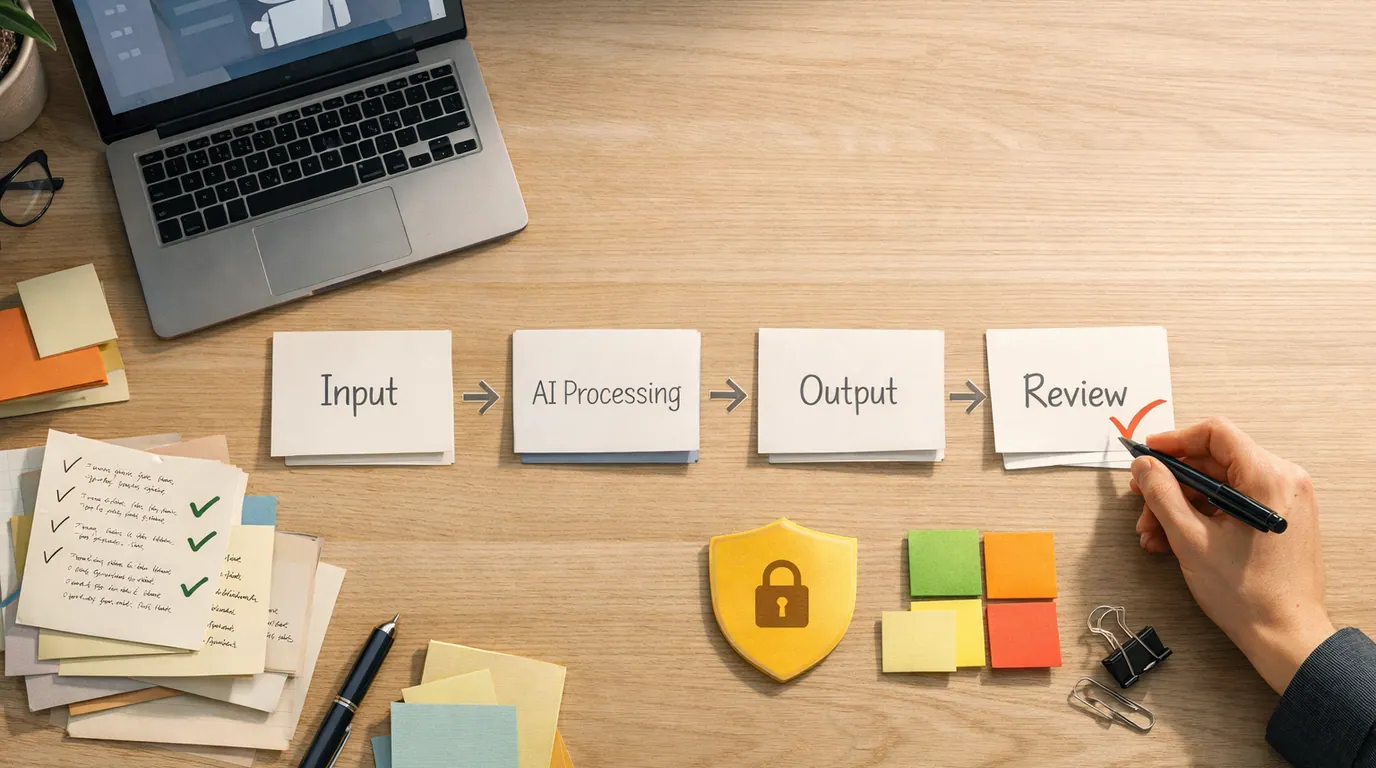
A useful AI automation for business workflow is a chain of small decisions, not one giant prompt. Keep each step narrow enough to test.
- Define the trigger. Name the event that starts the process: new ticket, form submission, file upload, meeting transcript, CRM change, spreadsheet row, or Slack message.
- Limit the context. Decide which fields, documents, policies, transcripts, records, or examples the AI may read. Exclude private or unnecessary data.
- Assign one AI job. Ask AI to classify, extract, summarize, draft, compare, forecast, or recommend. Avoid asking it to do every step at once.
- Set the output format. Require fields a person can inspect: confidence, source notes, missing information, recommended route, draft text, and reason for escalation.
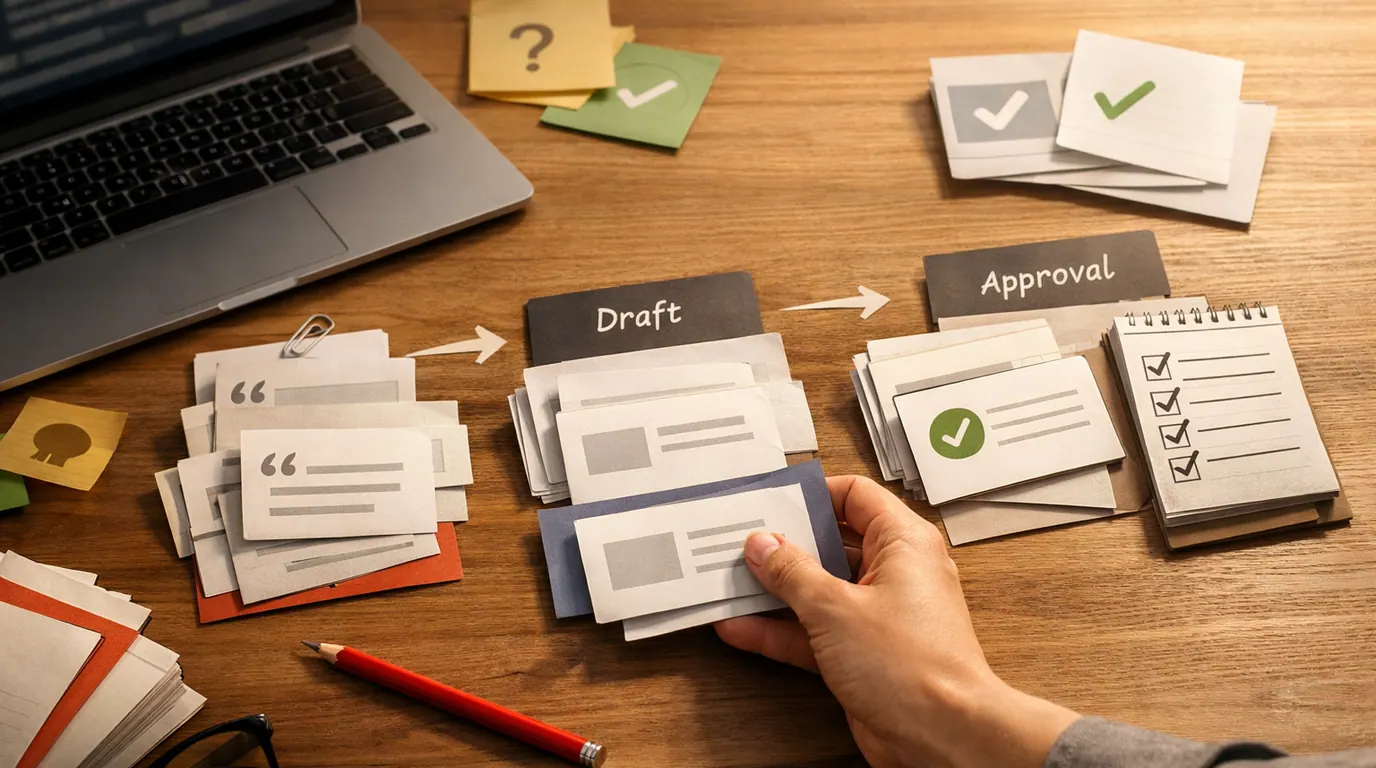
- Add the action. Create the task, draft the reply, update the record, route the ticket, send the alert, or pause for approval.
- Close the loop. Log what happened, capture edits, flag failures, and review a sample of completed runs every week.
The workflow should be boring to operate. If every run needs a clever prompt rewrite, the process is not ready. If every run produces the same fields, the same review path, and the same logs, you can improve it over time.
Use This AI Automation for Business Template
Copy this AI automation for business template into a planning doc before you build. It forces the team to define the work in business language before choosing a tool.
| Field | What to write | Example |
|---|---|---|
| Business goal | The operational result, not the tool name. | Reduce manual support triage and improve escalation consistency. |
| Workflow owner | The person accountable for quality, edits, and exceptions. | Support operations lead. |
| Trigger | The event that starts the automation. | New ticket arrives in the support queue. |
| Allowed context | The data AI can inspect. | Ticket text, customer tier, product area, help-center snippets, prior ticket tags. |
| AI task | The narrow judgment step. | Classify urgency, summarize the issue, suggest a category, and identify missing details. |
| Automation action | The system update or handoff. | Route to queue, create summary note, draft response, and flag escalation. |
| Review gate | What a person must approve before action. | External replies, refunds, legal issues, security issues, and high-value accounts. |
| Success measure | The workflow metric that proves value. | Lower triage time, fewer misroutes, faster first response, and lower rework. |
This template is deliberately plain. If the team cannot fill it out, the issue is not lack of AI sophistication. The issue is that the workflow is not defined enough to automate.
AI Automation for Business Strategy and Checklist
An AI automation for business strategy should fund workflows, not demos. A strong strategy chooses where AI belongs, where it does not, who owns each system, and what evidence is needed before scaling.
Use this AI automation for business checklist before a pilot reaches production:
- Workflow is named. The team can describe the start, end, owner, input, output, and exception path in one paragraph.
- Data boundary is approved. Customer records, employee data, contracts, financials, credentials, and confidential files are controlled.
- AI output is inspectable. The result is structured enough for review: fields, sources, confidence, rationale, missing information, or draft text.
- Human review is explicit. Sensitive, irreversible, customer-facing, HR, finance, legal, security, and compliance actions pause for approval.
- Run history is visible. Someone can see trigger data, AI output, app changes, errors, retries, and reviewer decisions.
- Failure path exists. The workflow knows what happens when data is missing, the model is uncertain, an app is down, or an output looks unsafe.
- Measurement is boring. Track cycle time, edit rate, rework, misroutes, response quality, adoption, and exception volume rather than novelty.
For broader planning, use the AI business strategy guide. For sensitive workflows, the privacy questions in AI privacy concerns are part of the implementation work, not a final legal checkbox.
Risks and Human Review Points
AI automation can make a bad process faster. The risks usually appear in the handoff: the AI misclassifies a request, a workflow sends a draft too early, a tool writes to the wrong record, or nobody notices that a connected app changed.
Works Well When
- The work repeats often enough that a small improvement compounds.
- The input is messy, but a person can quickly check the output.
- The workflow has a clear owner and a visible source of truth.
- The automation can start in draft, review, or suggestion mode.
- Failures can route to a human before customers, money, or permissions are affected.
Watch Out For
- The process is political, undefined, or different every time.
- The tool cannot show what it read, decided, changed, or failed to do.
- Private data would enter an unapproved system without retention and access controls.
- The workflow sends customer messages, updates financial records, or grants access without review.
- Nobody owns prompt changes, integration changes, alerts, test cases, or cleanup.
Do not automate around accountability. Automate the preparation, routing, summarizing, and drafting. Keep the named person responsible for the outcome.
The Bottom Line
AI automation for business is not a race to replace every manual step. It is a discipline for turning messy, repeated work into a cleaner handoff: one trigger, one AI task, one system action, one review gate, and one owner.
Start with a low-risk workflow such as lead intake, support triage, meeting follow-up, document extraction, internal request routing, or weekly reporting. Choose tools by workflow fit, not hype. Keep humans on sensitive decisions. Scale only when the team can explain the run history, measure the result, and improve the process without rebuilding it from scratch.
Frequently asked questions
What is AI automation for business?
AI automation for business means using AI inside a repeatable workflow to classify, summarize, extract, draft, route, forecast, or update work across business systems. It is different from basic automation because the AI step can interpret messy inputs, but the final workflow still needs owners, logs, and review.
What is the best AI automation for business?
The best AI automation for business depends on the workflow. Zapier and Make fit broad no-code app handoffs, n8n fits technical teams that need control, Microsoft Copilot fits Microsoft-heavy work, HubSpot fits CRM and marketing, Zendesk fits support, and Moveworks or Domo fit larger enterprise workflows. Check current pricing.
Which business process should I automate first?
Start with a frequent, low-risk handoff where the input is messy but the output is easy to inspect: lead intake, support triage, meeting follow-up, invoice field extraction, spreadsheet cleanup, reporting summaries, or internal request routing. Avoid irreversible customer, finance, legal, HR, or security decisions until controls are proven.
How is AI automation different from regular automation?
Regular automation follows fixed rules, such as creating a task when a form is submitted. AI automation can read an email, infer intent, extract fields, summarize context, classify urgency, and draft the next step. That flexibility helps with real-world variation, but it also requires test cases and human review.
Can a small business use AI automation without developers?
Yes, many small teams can start with no-code or low-code tools such as Zapier, Make, HubSpot, Asana, ClickUp, Zendesk, or Microsoft Copilot. The safer path is to automate one narrow workflow in review mode first, then expand only after the team can inspect outputs, permissions, data use, and failures.
What risks matter most in business AI automation?
The main risks are private data exposure, wrong classifications, broken integrations, hallucinated summaries, unapproved customer messages, weak audit logs, vendor lock-in, and unclear ownership. Put review gates around sensitive data, payments, customer promises, hiring, legal exposure, and source-of-record updates.