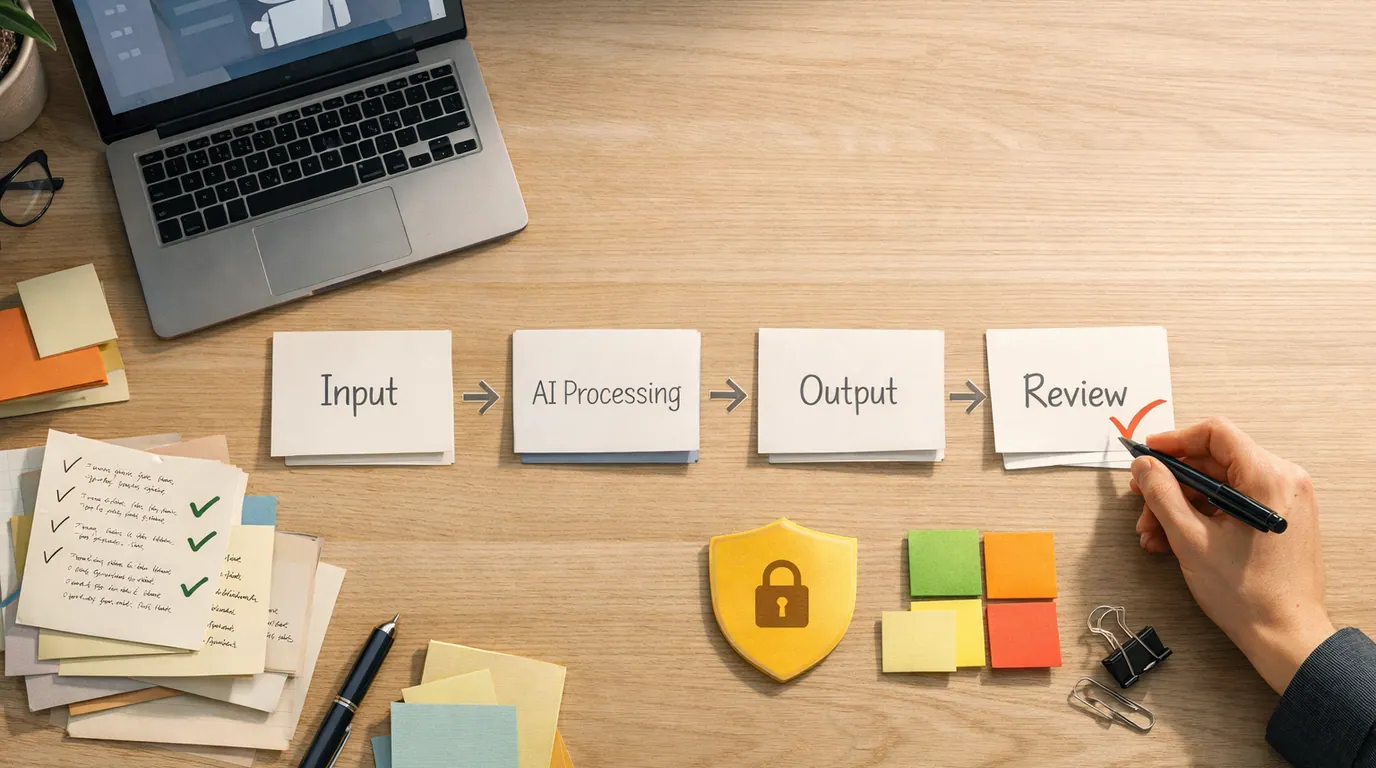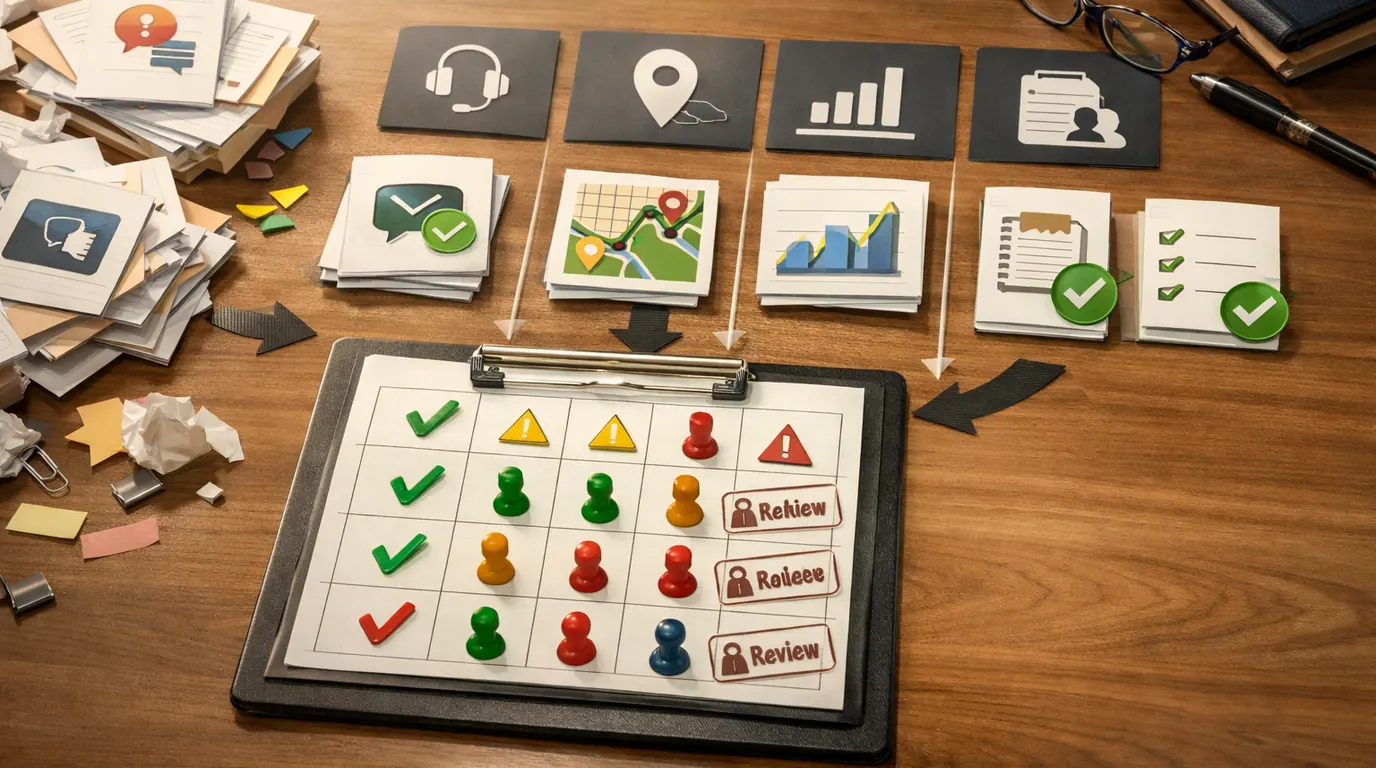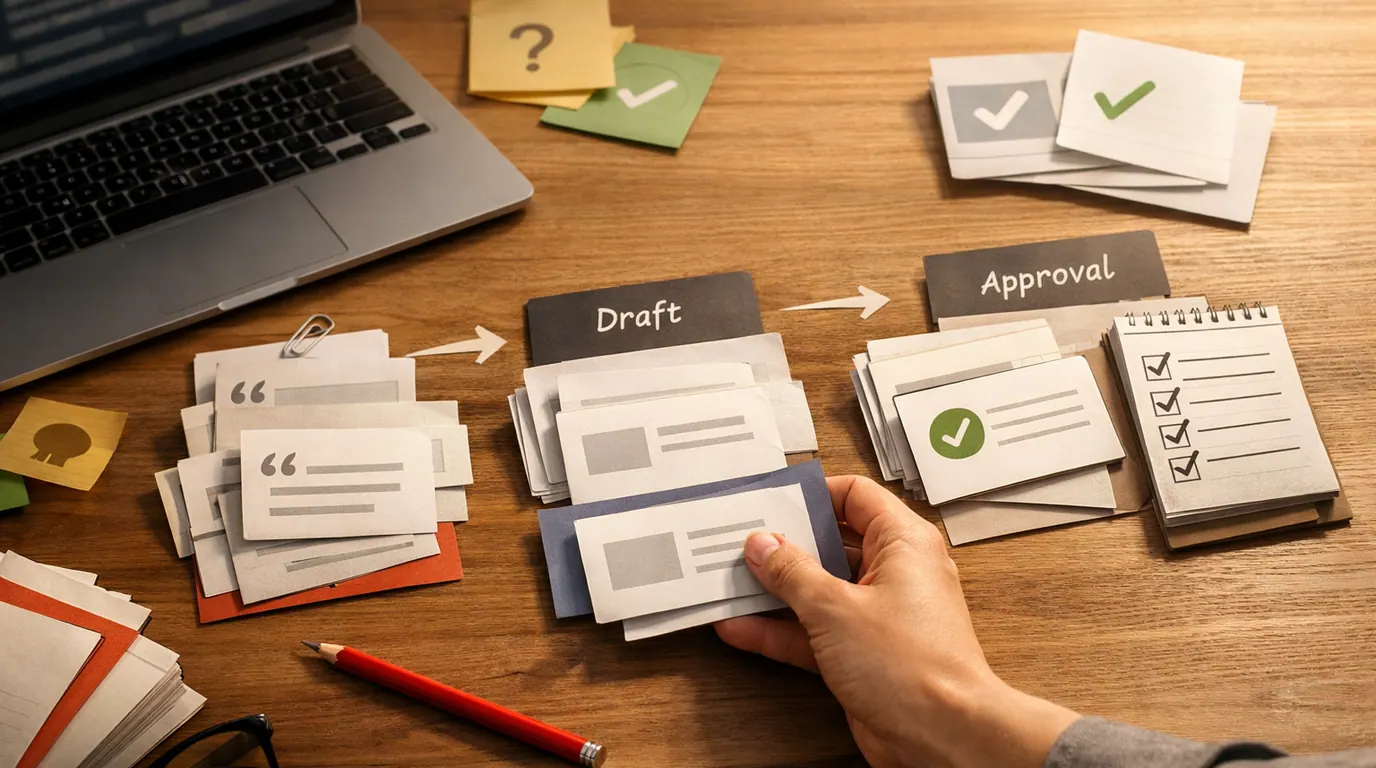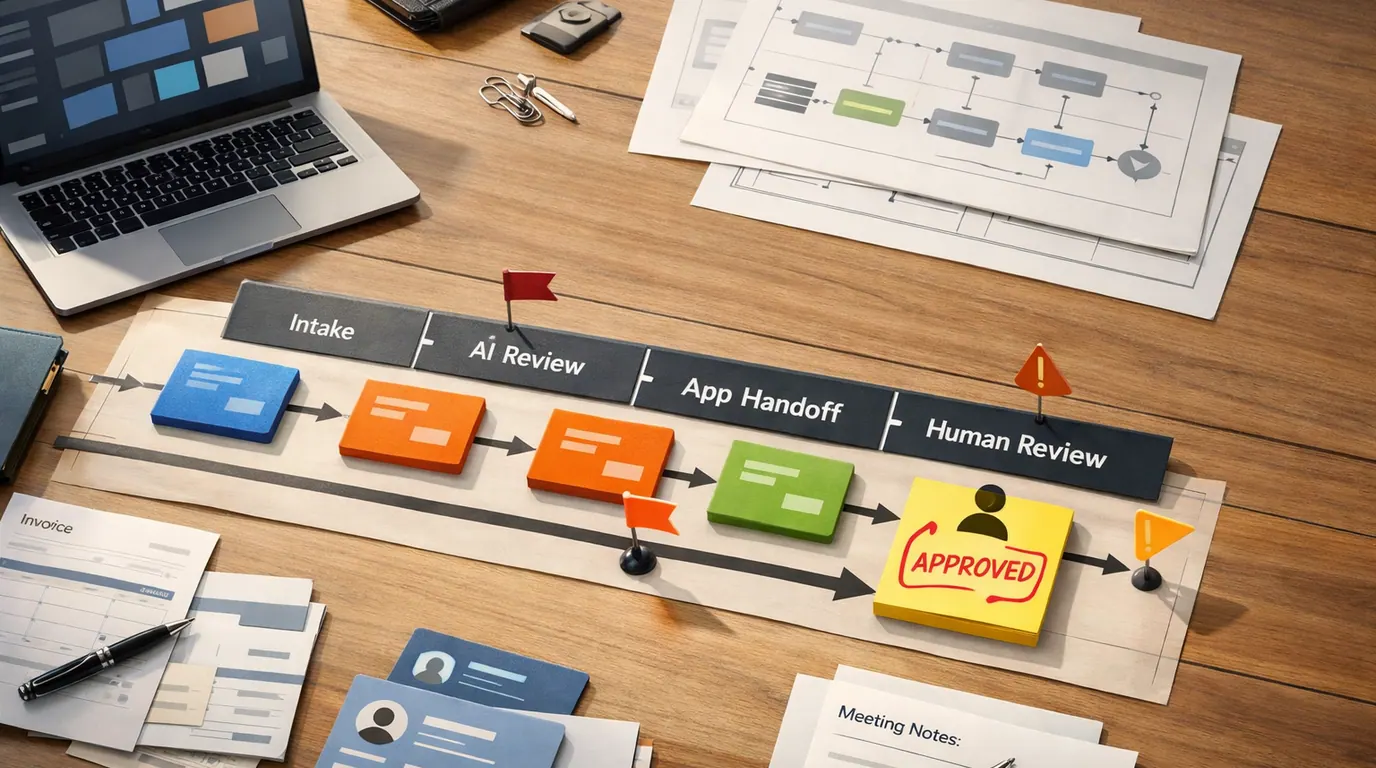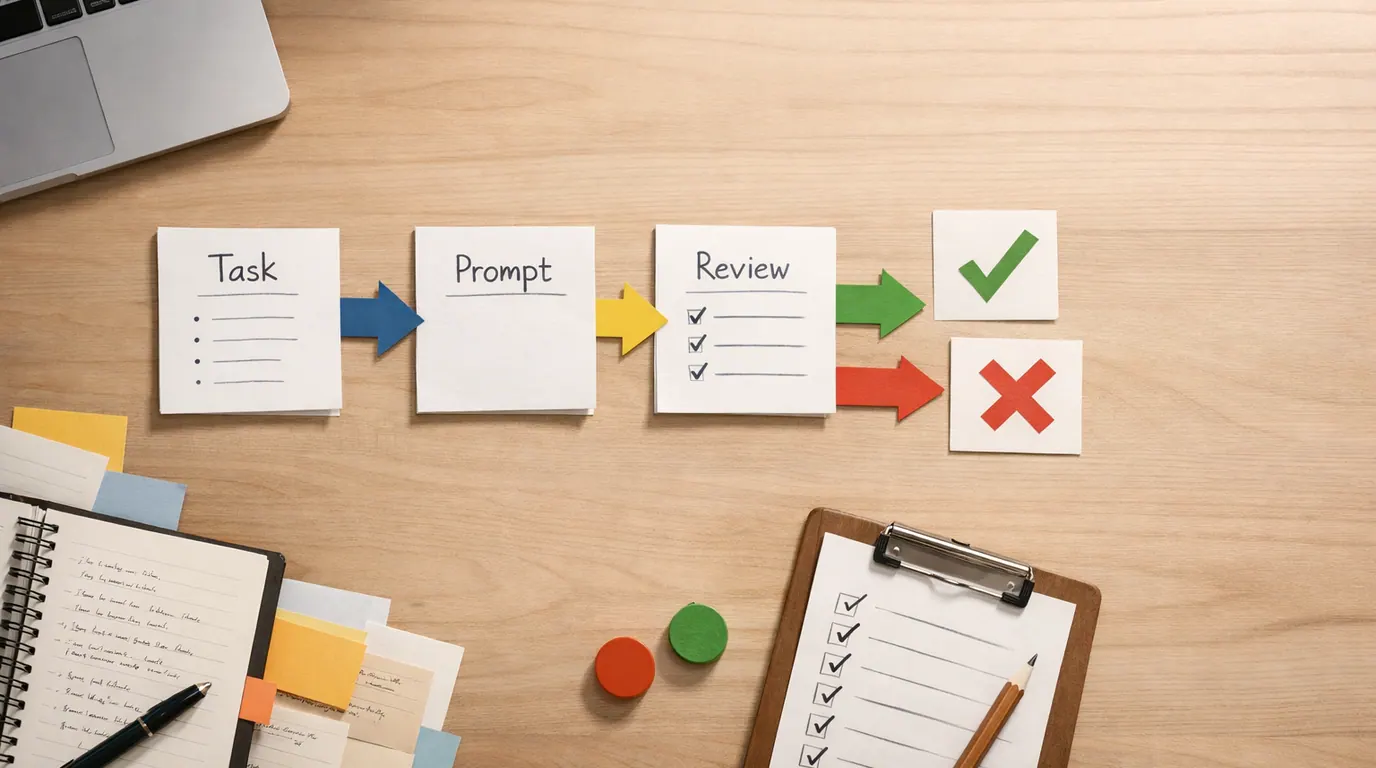
If you searched for “ai business ideas”, the useful answer is not a giant list of futuristic startups. The useful answer is a way to choose one idea you can test with a real buyer, real inputs, a clear workflow, and a human review point.
Most AI business ideas fail before the technology matters. The buyer is too vague, the data is unavailable, the workflow is not repeated often enough, or the founder builds a product before anyone has agreed to pay for the result. The useful AI business is usually the boring workflow that already has a budget, not the flashiest demo.
Use this AI business ideas guide as a practical filter. Start with customer pain, pick a small paid pilot, use existing AI where it can prepare work, and keep humans responsible for facts, judgment, sensitive data, and final decisions.
Find a task people already pay employees, agencies, consultants, or software to handle.
Sell a clear deliverable: cleaned records, routed tickets, draft replies, reports, qualified leads, or summarized documents.
Keep a person in charge when the output affects money, customers, employees, compliance, access, or public claims.
What Makes an AI Business Idea Worth Testing
An AI business idea is worth testing when AI can reduce the cost, delay, or complexity of a task the buyer already cares about. That does not mean the business has to train a new model. Many realistic ideas use existing models, APIs, workflow tools, knowledge bases, spreadsheet logic, CRM data, and human review.
Public lists from Shopify and Squarespace point to a useful pattern: many founders can start by applying existing AI to niche work instead of inventing the next foundation model. The harder part is choosing a problem with buyer urgency, available data, and a measurable result.
Use these five tests before you fall in love with an idea:
- Buyer clarity: you can name the exact role that owns the problem, such as a support manager, clinic administrator, broker, recruiter, agency owner, finance lead, or founder.
- Repeated input: the work arrives often enough to create value: tickets, calls, forms, invoices, resumes, listings, product pages, reports, chats, or meeting notes.
- Reviewable output: AI produces something a person can inspect, edit, approve, or reject before it reaches a customer or system of record.
- Data boundary: you know which information is public, internal, confidential, personal, regulated, or off-limits.
- Paid proof: the first version can be sold as a pilot, service, audit, workflow setup, or recurring package before you build a complete platform.
Quick Picks: Best AI Business Ideas by Founder Fit
The best AI business ideas depend on what you can sell, what you can safely deliver, and what buyer you can reach. Use this shortlist to find a realistic starting point, then narrow it to one customer segment before you build anything.
| Idea | Best for | First paid offer | AI role | Human review point |
|---|---|---|---|---|
| AI workflow audit and setup | Operators, consultants, agencies, and founders who understand messy business handoffs | Map one process, build a small automation, and document the review rule | Classify inputs, summarize context, draft actions, and route work between tools | Owner approves exceptions, customer messages, payments, access changes, and process changes |
| Support knowledge assistant | People who understand customer support, SaaS onboarding, ecommerce, or local service operations | Turn help docs and past tickets into a reviewed FAQ assistant or triage workflow | Find answers from approved docs, summarize issues, draft replies, and label urgency | Support lead checks facts, tone, policy, account details, and escalations |
| Lead research and CRM cleanup service | Sales operators, marketers, and founder-led B2B teams | Clean a CRM segment, enrich missing fields, score fit, and draft follow-up notes | Deduplicate records, extract firmographic clues, summarize accounts, and prepare outreach | Sales owner verifies consent, claims, targeting, territory, and account facts |
| Industry-specific content operations studio | Writers, marketers, designers, and niche experts with distribution | Build briefs, draft variants, repurpose long content, and create an approval checklist | Turn source material into outlines, briefs, email drafts, social posts, and QA passes | Editor verifies sources, brand voice, promises, legal claims, and sensitive topics |
| Document intake and review prep | Operators with domain knowledge in insurance, finance, real estate, legal admin, procurement, or HR | Extract fields from documents and prepare a reviewer packet | Summarize files, flag missing data, compare forms, and prepare questions | Qualified human verifies amounts, identities, compliance, eligibility, and final decisions |
| AI receptionist or appointment triage | Local service operators, clinic admins, agencies, and appointment-heavy businesses | Create a call, chat, or form intake flow that routes requests to the right person | Ask intake questions, summarize the request, classify urgency, and draft handoff notes | Staff approves booking rules, sensitive cases, emergency language, and customer-facing replies |
| Team training and onboarding assistant | People who understand internal operations, SOPs, enablement, HR, or customer success | Convert policies, SOPs, and examples into a searchable assistant with quizzes and review | Answer from approved materials, create practice scenarios, and summarize gaps | Manager checks policy accuracy, employee data use, and training recommendations |
| Spreadsheet and reporting copilot | Finance, ops, analytics, and admin specialists who know everyday reporting pain | Clean reports, explain variances, prepare dashboards, and write recurring summaries | Classify rows, spot anomalies, draft commentary, and generate formulas or checks | Owner verifies source numbers, formulas, assumptions, and decisions before sharing |
| Recruiting admin workflow | Recruiters, HR consultants, and hiring operations teams | Draft role briefs, summarize resumes, prepare interview packets, or clean ATS notes | Summarize candidate material, draft outreach, and organize interview evidence | Recruiter or HR owner controls shortlists, rejection, accommodations, and legal compliance |
| Vertical AI micro-SaaS from a proven service | Technical founders who already have pilot customers and repeated workflow examples | Start with a done-for-you service, then productize the repeated steps | Automate the repeatable classification, extraction, generation, or routing layer | Customer success reviews output quality, edge cases, security, and onboarding risk |
This table is a starting map, not a guarantee of profit. Choose the idea where you can reach buyers this week, collect real examples, and sell a narrow result. A broad “AI for small business” offer is harder to sell than “we reduce support ticket triage time for Shopify-style stores by turning your help docs into a reviewed reply workflow.”
Choose Your AI Business Ideas Strategy
Your AI business ideas strategy should decide what you will not build yet. A first-time founder usually has three realistic paths:
| Path | What you sell first | Good when | Watch for |
|---|---|---|---|
| Service-first | A done-for-you audit, setup, cleanup, report, or recurring workflow | You can reach buyers, understand the domain, and deliver manually while using AI for leverage | Service margins disappear if every client needs a custom mess and no reusable process emerges |
| Productized service | A fixed package with a defined input, output, turnaround time, and review process | The workflow repeats across similar clients and the deliverable is easy to explain | Too many custom promises turn the package back into consulting |
| SaaS or agent product | A software workflow that customers run themselves | You have repeated examples, clear permissions, integration needs, and enough demand from pilots | Building too early can hide weak demand, weak data access, and support burden |
For most founders, service-first is the honest first move. It lets you learn how the buyer describes the problem, what data they can actually share, which outputs they trust, and where the workflow breaks. Once three to five clients ask for the same thing, you have evidence for a productized service or software layer.
Score each idea from 1 to 5 on these criteria:
- Buyer access: can you speak to ten likely buyers without paid ads or months of audience building?
- Pain intensity: does the problem waste money, delay revenue, create risk, or frustrate customers today?
- Repeat frequency: does the task happen daily, weekly, or every deal cycle?
- Input quality: can buyers provide examples, documents, tickets, calls, forms, spreadsheets, or records?
- Review burden: can a person check the output quickly, or does review require a licensed expert every time?
- Launch speed: can you create a useful pilot with existing tools in two weeks?
- Defensibility: can you build process knowledge, templates, data structure, integrations, or distribution that improves over time?
An idea with a smaller market and a reachable buyer often beats a massive market where you have no trust, no data, and no distribution.
An AI Business Ideas Workflow From Problem to Paid Pilot
Use this AI business ideas workflow when you are comparing options. It keeps the project grounded in proof instead of imagination.
- Pick one buyer role. Name the person who feels the pain and controls the budget: owner, ops lead, support manager, sales director, recruiter, broker, clinic admin, or finance lead.
- Collect messy examples. Ask for anonymized tickets, forms, calls, invoices, spreadsheets, customer questions, briefs, listings, or reports that show the real task.
- Map the before state. Write who touches the work, how long it takes, what goes wrong, which tools are involved, and what a good output looks like.
- Choose one AI job. Pick classify, extract, summarize, draft, compare, enrich, route, or ask follow-up questions. Do not automate the whole business.
- Build a reviewed pilot. Use existing AI tools, spreadsheets, forms, automation, and manual QA to produce the promised output for one client.
- Measure the result. Track edit rate, time saved, error reduction, response speed, revenue impact, customer satisfaction, or avoided cleanup.
- Productize only the repeated part. Turn the recurring inputs, prompts, schemas, checks, and handoffs into templates or software after the pilot proves demand.
If the buyer will not provide examples, the workflow probably matters less than they say. If the buyer provides examples but will not pay for a pilot, the value may be unclear. If the pilot works only because you personally rescue every edge case, the next business step is a tighter niche, not more automation.
AI Business Ideas Examples You Can Adapt
The strongest AI business ideas use cases are practical, narrow, and close to existing spend. These AI business ideas examples show how a generic idea becomes a sellable offer.
| Generic idea | Sharper offer | Everyday input | Proof to collect |
|---|---|---|---|
| AI customer support | Set up a help-doc answer assistant and support triage flow for ecommerce stores with more than 50 weekly tickets. | Help center pages, order policies, support tickets, refund rules, shipping questions. | Lower first-response time, fewer repeated questions, lower edit rate, clearer escalations. |
| AI lead generation | Clean and score inbound demo requests for B2B SaaS teams, then draft account-specific follow-up notes. | CRM records, form submissions, website events, account notes, target-customer rules. | Faster routing, better qualification notes, higher meeting acceptance, lower manual research time. |
| AI content business | Turn webinars and customer interviews into reviewed briefs, emails, social posts, and sales enablement snippets. | Transcripts, product pages, customer quotes, launch notes, brand examples. | More reusable assets per source, faster review, fewer unsupported claims. |
| AI reporting | Prepare a weekly finance or operations summary from spreadsheets and source-system exports. | CSV exports, spreadsheet tabs, dashboard screenshots, manager notes. | Fewer manual copy-paste steps, clearer variance notes, fewer formula mistakes. |
| AI recruiting | Prepare recruiter review packets from resumes, job criteria, interview notes, and scorecards. | Job descriptions, resumes, applicant records, interview notes, screening criteria. | Cleaner shortlists, faster review, consistent evidence, documented human decisions. |
| AI real estate assistant | Draft listing descriptions, summarize buyer preferences, and route follow-up tasks for small broker teams. | Listing data, showing notes, buyer emails, local rules, CRM tasks. | Faster listing prep, fewer missed follow-ups, accurate factual review. |
Several of these connect to deeper playbooks. Use AI workflow automation when the main offer is moving work between systems, AI for lead generation when the buyer cares about pipeline, How to Build an AI Chatbot when the idea involves a conversational assistant, and AI for Recruitment when the workflow touches hiring decisions.
Copy This AI Business Ideas Template
Use this AI business ideas template before you name the company, buy a domain, or build a demo. It is designed to expose weak assumptions early.
Idea name:
[Short working name]

Buyer:
[Specific role, company type, team size, industry, geography if relevant]

Painful workflow:
[The repeated task, queue, or decision that wastes time, money, or attention]

Current workaround:
[Who does it today, what tools they use, how long it takes, what breaks]

Inputs available:
[Tickets, transcripts, documents, forms, CRM records, spreadsheets, images, emails, calls, policies]

AI job:
[Classify, extract, summarize, draft, compare, enrich, route, ask questions, or monitor]

Human review rule:
[What a person must verify before the output is used]

First paid offer:
[Audit, cleanup, setup, pilot, report, dashboard, assistant, or recurring service]

Success measure:
[Time saved, response speed, error reduction, revenue recovered, leads qualified, rework reduced]

Risk boundary:
[Private data, regulated decisions, customer promises, legal/financial/medical/hiring issues, security limits]

Distribution path:
[How you will reach 10 buyers this week]

Next test:
[The smallest paid or high-commitment action you can ask for]
This template is deliberately plain. A strong answer should make the business feel smaller and more concrete. A weak answer usually includes phrases like “all small businesses”, “any workflow”, “AI agent platform”, or “fully automated” without a buyer, input, review rule, or paid test.
For prompt-heavy offers, adapt the briefing structure in ChatGPT Prompts for Business and How to Write Better AI Prompts. A prompt is not the business, but a reusable prompt plus examples, data rules, QA checks, and workflow ownership can become part of the delivery system.
AI Business Ideas Checklist Before You Launch
Use this AI business ideas checklist before you start selling or building. If you cannot answer these questions, you are still in discovery.
- Name the buyer: Which role owns the pain and can approve payment?
- Name the repeated task: What exact work happens often enough to matter?
- Collect examples: Can you get five to twenty real or anonymized samples?
- Define the output: What will the buyer receive, approve, or use?
- Set the review point: Which facts, claims, data, and decisions require a human?
- Choose the first delivery mode: Will you sell an audit, pilot, productized service, or software prototype?
- Price the pilot: What small paid offer proves the buyer values the result?
- Track one metric: Which before-and-after measure proves improvement?
- Write the stop rule: When should the workflow pause, escalate, or refuse to act?
- Protect the data: Which information must be redacted, kept in approved tools, or never uploaded?
Do not skip the paid test. Praise, survey answers, and “this is interesting” are weak signals. A paid pilot, shared workflow examples, access to a real process, or a scheduled stakeholder review is stronger evidence.
What to Avoid When Building an AI Business
AI can make a weak business idea look more complete than it is. A polished prototype, slick generated copy, or agent demo can hide the fact that nobody owns the problem, no data is available, or the buyer would rather keep using a spreadsheet.
Works Well When
- The task is repeated and painful enough that someone already pays for it.
- The first deliverable can be reviewed by a person before it affects customers or records.
- The buyer can provide real examples and describe what good output looks like.
- The first version can run with existing AI, workflow tools, and manual quality control.
- The business can become more valuable through niche process knowledge, templates, integrations, or distribution.
Watch Out For
- The idea depends on vague claims such as fully autonomous, any industry, or passive income.
- The workflow touches sensitive data or regulated decisions without expert oversight.
- The buyer cannot share examples, define success, or explain how the task is handled today.
- The output is hard to verify, but the business plan assumes customers will trust it automatically.
- The founder wants to build software before selling a narrow pilot.
Use extra caution in medical, legal, finance, insurance, hiring, education, identity, cybersecurity, and employee monitoring workflows. Those ideas may have real demand, but they also need stronger data controls, documentation, expert review, and vendor checks. The privacy rules in AI Privacy Concerns are a useful starting point before any client data enters an AI system.
Do
- Sell one measurable workflow before building a platform.
- Ask for real examples before writing prompts or buying tools.
- Keep the human review step visible in the offer.
- Document what the AI may not do.
Do not
- Promise autonomous decisions where accountability matters.
- Use private customer, employee, or regulated data in unapproved tools.
- Confuse generated output with verified business evidence.
- Build for a market you cannot reach.
The Bottom Line
AI business ideas become real businesses when they move from “AI could do this” to “this buyer pays for this painful workflow, provides these inputs, reviews this output, and measures this result.”
Start with a service or pilot, not a grand platform. Pick one buyer, collect real examples, use AI for a bounded job, keep a human accountable, and charge for a small outcome. If the same workflow repeats across clients, then you have earned the right to productize it.
Frequently asked questions
What are good AI business ideas for a beginner?
Good beginner AI business ideas are service-first and narrow: support triage setup, CRM cleanup, lead research, content repurposing, chatbot implementation, reporting dashboards, or document summarization with review. They use existing tools, solve a problem someone already pays for, and can be tested with one client.
What is the best AI business idea to start in 2026?
There is no single best AI business idea for every founder. The best fit is where you already understand the buyer, can reach prospects, can access enough workflow examples, and can prove value in a paid pilot. For most small teams, an AI-enabled service is safer than building a full SaaS product first.
Do I need to build my own AI model to start an AI business?
Usually no. Most practical AI businesses can begin with existing models, APIs, no-code automation, retrieval from approved documents, and a human review workflow. Training or fine-tuning a model only makes sense when you have proprietary data, repeated volume, and a clear reason prompts and retrieval are not enough.
How do I validate an AI business idea before building?
Validate by interviewing a narrow buyer, collecting real examples of the task, pricing a small pilot, delivering a manual or semi-automated version, and measuring the before-and-after result. If people will not share examples, pay for the pilot, or review the output, the idea is not ready to become a product.
What AI business ideas are risky?
Risk rises when the idea handles medical, legal, financial, hiring, insurance, education, identity, security, or private customer data. Those ideas can still be viable, but they need stronger vendor review, data controls, audit logs, expert oversight, and a clear rule that AI prepares work rather than making final decisions.
How can a solo founder choose between AI business ideas?
Score each idea on buyer access, pain intensity, repeat frequency, data availability, review burden, launch speed, and ability to charge for a pilot. Choose the idea with the clearest customer and fastest paid proof, not the idea with the most impressive demo or the broadest market story.