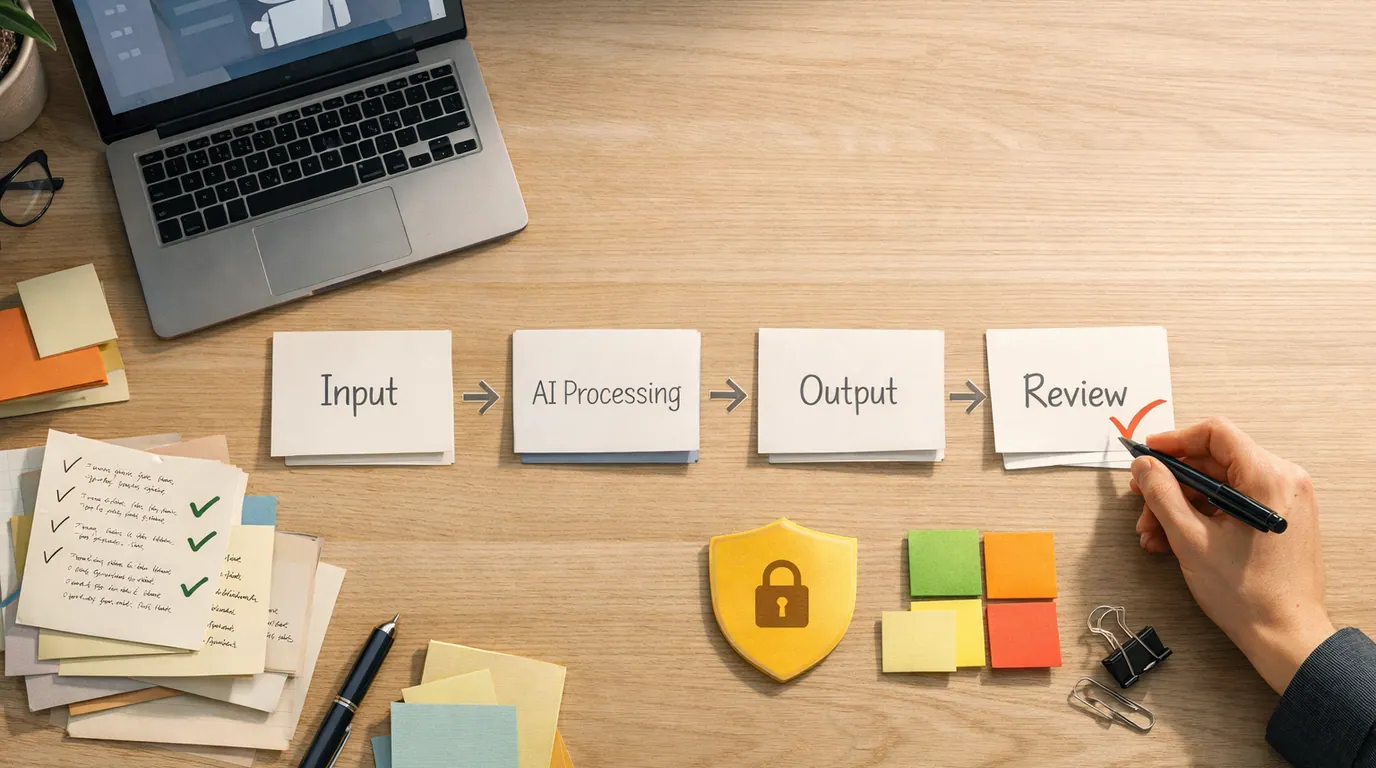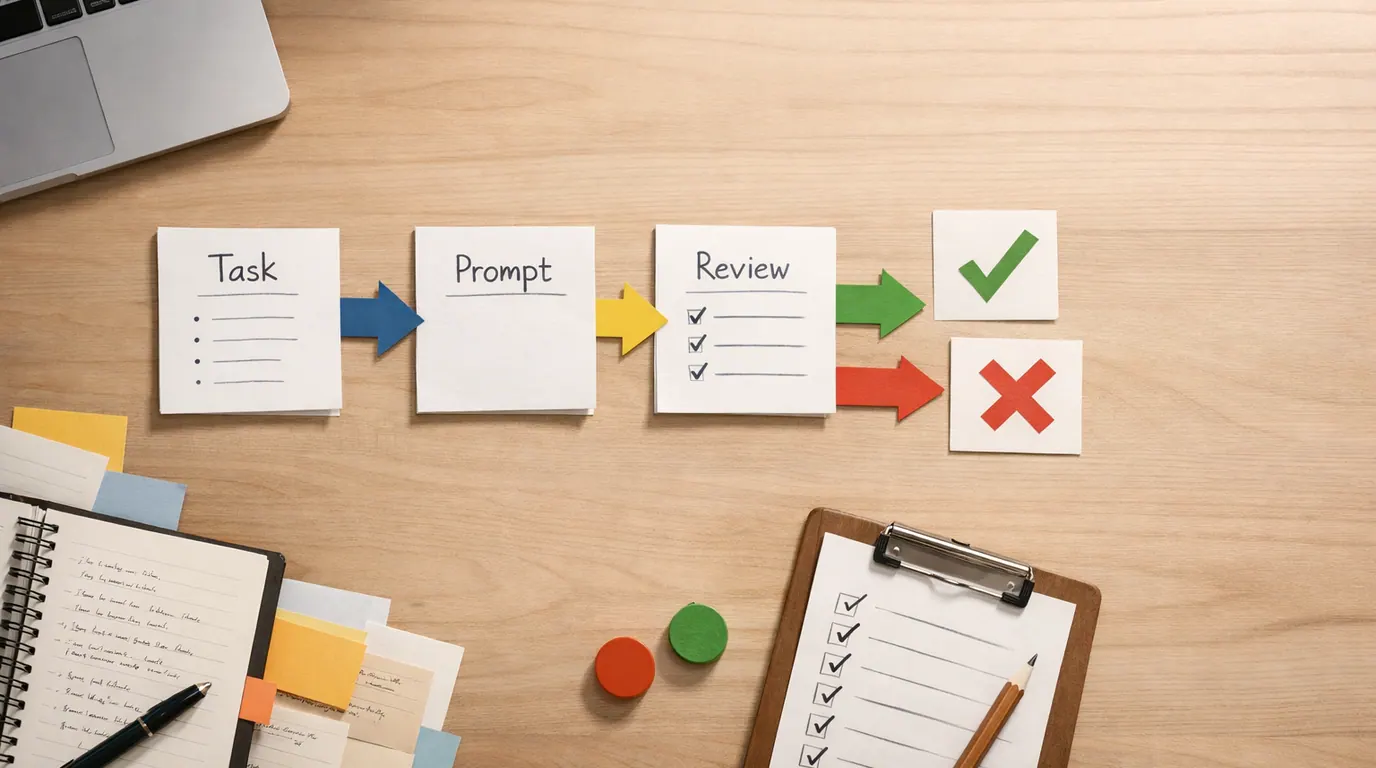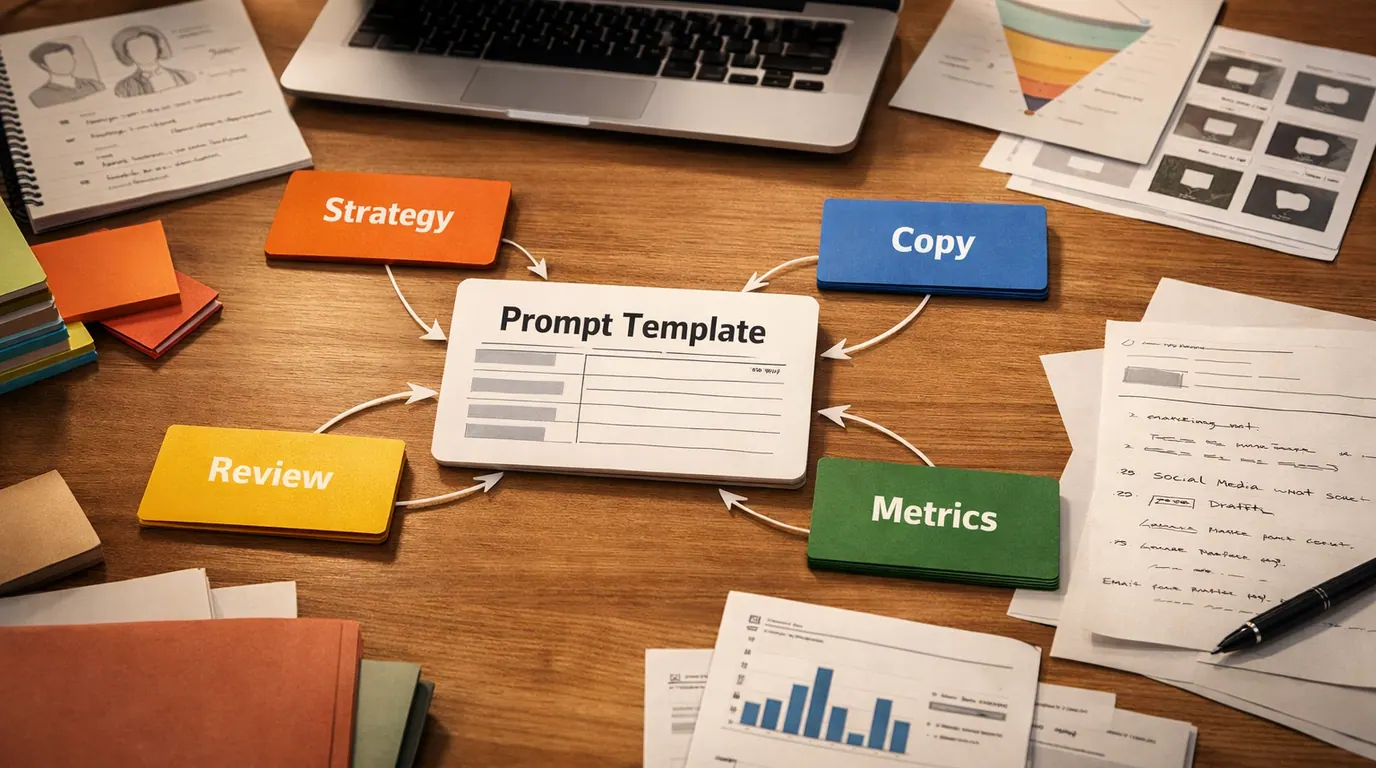
If you searched for “chatgpt prompts for marketing”, the useful answer is not a giant list of clever sentences. ChatGPT helps marketing work when you treat the prompt as a brief: what audience you serve, what offer you are promoting, what channel you are using, what source material is true, and how a human will review the result.
A marketing prompt is not a spell; it is a compact creative brief with enough context for the model to stop guessing.
Strong ChatGPT prompts for marketing do four practical jobs: they clarify strategy, create draft options, stress-test messaging, and turn messy notes into usable next actions. The best ChatGPT prompts for marketing also make review easier, because they ask the model to flag assumptions, unsupported claims, and places where the output may sound generic.
Choose the workflow stage before asking for copy, strategy, or analysis.
Use customer language, offer details, source notes, channel constraints, and brand voice.
Verify facts, privacy, compliance, tone, differentiation, and whether the idea is worth shipping.
Start With the Marketing Job, Not the Prompt
Most weak marketing prompts fail because they ask for a final asset too early. “Write five ads for our product” leaves ChatGPT to guess the audience, buying trigger, proof, objection, platform, offer, and approval standard.
Use this ChatGPT prompts for marketing guide by choosing the job first:
Business: [what you sell and who buys it]
Offer: [product, service, feature, webinar, report, trial, discount, launch, or update]
Audience: [role, segment, awareness level, pain point, objection]
Channel: [email, LinkedIn, landing page, search ad, blog, webinar, sales enablement]
Source material: [customer quotes, product notes, research, campaign brief, analytics, constraints]
Brand voice: [plain, expert, playful, calm, technical, founder-led, enterprise-ready]
Do not use: [banned claims, words, angles, legal risks, competitor names, unsupported numbers]
Output: [table, outline, copy variants, checklist, brief, critique, next actions]
Human review: [facts, privacy, brand fit, compliance, channel fit, differentiation]
That setup works better than a longer magic prompt because it tells the model what matters. If you are building your broader prompting habit, use the same task, context, criteria, format, and review pattern from our guide to writing better AI prompts.
Prompt Library: ChatGPT Prompts for Marketing
The table below covers the highest-value ChatGPT prompts for marketing use cases. Pick the row that matches your bottleneck, then use the copyable templates in the next section.
| Marketing job | Use when | Prompt result | Human review |
|---|---|---|---|
| Audience and positioning | You need sharper customer language before drafting assets | Segments, pain points, objections, value proposition angles | Check against real customer calls, surveys, and sales notes. |
| Campaign strategy | You have a launch, webinar, offer, or content push to plan | Campaign thesis, channels, message map, sequence, risks | Verify budget, timeline, audience evidence, and approval steps. |
| Content calendar | You need repeatable topics across blog, email, and social | Themes, post ideas, distribution plan, repurposing paths | Reject filler topics and anything unsupported by expertise. |
| Social media copy | You need platform-specific hooks and post variants | Captions, hooks, angles, CTAs, repurposed snippets | Remove generic hype and adjust for platform behavior. |
| Email marketing | You need a sequence, newsletter, or nurture draft | Subject lines, email structure, body copy, segmentation ideas | Check promises, tone, deliverability risks, and unsubscribe clarity. |
| SEO content brief | You need a useful page plan before drafting | Search intent, outline, examples, FAQs, internal link ideas | Confirm keyword fit, source quality, and factual accuracy. |
| Ad and landing page copy | You need concise variants for a specific offer | Headlines, value propositions, objections, CTAs, test ideas | Review claims, compliance, landing page match, and proof. |
| Analytics summary | You need to explain campaign performance | Plain-language readout, likely drivers, questions, next tests | Verify calculations and do not treat guesses as causation. |
| Repurposing | You need to turn one asset into many channel assets | A channel map, edited variants, and reuse checklist | Make sure every version still fits its channel and audience. |
The point is not to paste every prompt into every project. Use ChatGPT prompts as a repeatable intake system: strategy first, assets second, critique before publishing.
Copyable ChatGPT Prompts for Marketing Examples
These ChatGPT prompts for marketing examples are templates, not scripts to publish as-is. Replace the brackets with real context, paste source material when you have it, and keep the review instruction at the end.
1. Audience and positioning prompt
Use this before copywriting when you have customer notes, sales-call themes, review snippets, or survey responses.
Act as a practical marketing strategist.

I sell: [product or service]
Audience: [segment, role, company type, skill level, or buying situation]
Source material: [paste customer quotes, sales notes, survey responses, reviews, or product notes]
Goal: identify the most useful positioning angles before we create campaign assets.

Return a table with:
- Audience segment
- Pain point in the customer's language
- Desired outcome
- Main objection
- Proof we would need
- Messaging angle
- Risk if we overclaim

Do not invent customer quotes or statistics. If the source material is thin, tell me what evidence is missing.
Human review: compare every pain point with real customer evidence. If the model invents a neat phrase that no customer would say, treat it as a draft headline, not research.
2. Campaign strategy prompt
When people look for ChatGPT prompts for marketing strategy, they usually need a plan that connects message, channel, timeline, and measurement. This prompt keeps the model from jumping straight to slogans.
Act as a senior campaign planner.

Campaign goal: [pipeline, trial signups, demo requests, event registrations, product education, retention]
Offer: [what we want the audience to take action on]
Audience: [who we are targeting and what they already believe]
Current context: [market timing, launch reason, objections, competitors, constraints]
Available assets: [blog posts, case studies, reports, webinars, demos, customer quotes, product pages]
Channels we can use: [email, paid search, LinkedIn, partners, website, sales, community, events]
Constraints: [budget, timeline, approvals, compliance rules, team capacity]

Build a campaign plan with:
1. One campaign thesis
2. Three message angles and when to use each
3. A two-week or four-week channel sequence
4. Required assets
5. Risks and assumptions
6. Metrics to watch
7. The first five actions for the team

Flag anything that needs real customer, product, legal, or analytics verification.
Human review: look for attractive plans that ignore your actual team capacity. A good campaign plan has an owner, a sequence, and a check on whether the proof exists.
3. Content calendar prompt
This works for blog, newsletter, podcast, video, and LinkedIn planning when you want ideas with a reason behind them.
Create a 30-day content calendar for [brand, product, or creator].

Audience: [who the content serves]
Business goal: [awareness, education, leads, onboarding, retention, sales support]
Core topics: [3 to 6 topic areas]
Source assets: [existing posts, webinars, customer questions, research, product notes, case studies]
Voice: [tone and examples]
Channels: [blog, newsletter, LinkedIn, X, YouTube, TikTok, webinars, sales enablement]
Do not cover: [irrelevant topics, risky claims, overused angles]

Return:
- Weekly theme
- Primary asset idea
- Supporting social or email ideas
- Search or audience intent
- Why the topic matters now
- Proof or source material needed
- Repurposing path

Prioritize useful topics over volume.
Human review: remove topics that exist only because they sound publishable. If you cannot name the reader’s problem, evidence, or next action, the calendar item is not ready.
4. Social media prompt
Good social prompts are channel-specific. A LinkedIn thought-leadership post, a short-form video hook, and a product announcement need different structures.
Act as a social media editor for [brand or creator].

Platform: [LinkedIn, X, Instagram, TikTok, YouTube Shorts, Threads]
Audience: [who will see this]
Topic or asset to promote: [paste source material or summarize the idea]
Goal: [start a conversation, drive clicks, explain a feature, announce, educate, recruit]
Voice: [direct, expert, playful, founder-led, technical, concise]
Avoid: [clickbait, false urgency, generic inspiration, overused phrases]

Create:
- 10 post angles grouped by audience pain point
- 5 hooks for the strongest angle
- 3 full post drafts in different tones
- 5 comment prompts or follow-up ideas
- A note on what would make each post feel generic

Do not invent product capabilities, customer results, or statistics.
Human review: read each post out loud. If it could be posted by any company in your category, add product detail, customer language, or a sharper point of view.
5. Email sequence prompt
Use this for launch sequences, webinar reminders, onboarding, newsletters, reactivation, or sales-nurture emails.
Plan and draft an email sequence for [campaign or offer].

Audience: [segment and awareness level]
Offer: [what action we want]
Reader's likely objection: [why they may ignore, delay, or distrust it]
Proof available: [case study, testimonial, demo, product detail, founder note, data, guide]
Sequence length: [number of emails]
Tone: [plain, executive, technical, warm, concise]
Constraints: [compliance, claims, terms, links, CTA, unsubscribe expectations]

Return a sequence table with:
- Email number
- Purpose
- Subject line options
- Preview text
- Main message
- CTA
- Proof needed

Then draft the first email and mark any claims that need verification.
Human review: check every promise and timing claim. Email copy can sound persuasive while quietly creating legal, deliverability, or customer-trust problems.
6. SEO content brief prompt
Use this before drafting a blog post, landing page, comparison page, glossary page, or help-center article.
Act as an SEO content strategist who cares about reader usefulness.

Primary keyword: [keyword]
Search intent: [what the reader is trying to learn or decide]
Audience: [reader type and knowledge level]
Business fit: [why this topic matters to the company]
Known source material: [product notes, expert notes, docs, interviews, examples, research]
Internal links to consider: [existing URLs or pages]
Competitor patterns noticed: [only if known from real research]

Create a content brief with:
- Reader job
- Angle that is more useful than a generic article
- H2 outline
- Concrete examples to include
- Questions the page should answer
- Internal link opportunities
- Claims that require verification
- What not to include

Do not invent sources or pretend to have checked live search results.
Human review: a brief is not useful just because it has keywords. It should tell the writer what to prove, what examples to use, and how to avoid a generic article.
7. Ad and landing page copy prompt
Use this when you need concise copy variants, but do not ask for final ad claims without a compliance pass.
Act as a conversion copy reviewer and copywriter.

Offer: [product, service, trial, demo, lead magnet, event]
Audience: [segment and buying trigger]
Problem: [specific pain]
Desired outcome: [what they want after solving it]
Proof: [customer quote, feature, result, demo, review, guarantee, credential]
Landing page context: [page section, ad group, search intent, campaign angle]
Voice: [brand voice]
Restrictions: [banned claims, legal requirements, competitor rules, character limits]

Create:
- 8 headline options
- 8 subhead options
- 5 CTA options
- 4 objection-handling bullets
- 3 ad variants matched to the landing page
- A table of risky claims and safer alternatives

Keep the copy specific, but flag anything that needs proof before publishing.
Human review: match the ad to the landing page. A strong ad with a weak or mismatched page creates wasted clicks and misleading expectations.
8. Analytics summary prompt
This prompt helps turn campaign data into a discussion draft. It is not a substitute for checking formulas, attribution settings, or tracking quality.
Act as a marketing analyst explaining campaign performance to a non-technical team.

Campaign: [name and goal]
Time period: [date range]
Channels: [channels included]
Data: [paste anonymized or approved metrics table]
Known context: [budget changes, launches, tracking issues, seasonality, creative changes]
Decision needed: [what the team must decide next]

Return:
1. Plain-language summary
2. What improved
3. What declined
4. Possible explanations, labeled as hypotheses
5. Questions the data cannot answer
6. Recommended next tests
7. Metrics to verify before sharing

Do not claim causation unless the data supports it. Show any calculation assumptions.
Human review: verify the numbers outside the chat. Marketing data often has tracking gaps, attribution quirks, and campaign naming problems that a model cannot detect from a pasted summary.
A Reusable ChatGPT Prompts for Marketing Workflow
Use this ChatGPT prompts for marketing workflow when the output matters enough to review, but not enough to create a custom process from scratch every time.
- Define the stage. Are you researching, positioning, planning, drafting, editing, repurposing, or reporting? One prompt should usually serve one stage.
- Paste the real inputs. Use approved customer language, product notes, campaign constraints, past performance, examples, and internal rules.
- Ask for options before copy. Request angles, tradeoffs, assumptions, and risks before asking for a finished asset.
- Choose one direction. A human should select the strongest angle based on strategy, not because the model ranked it first.
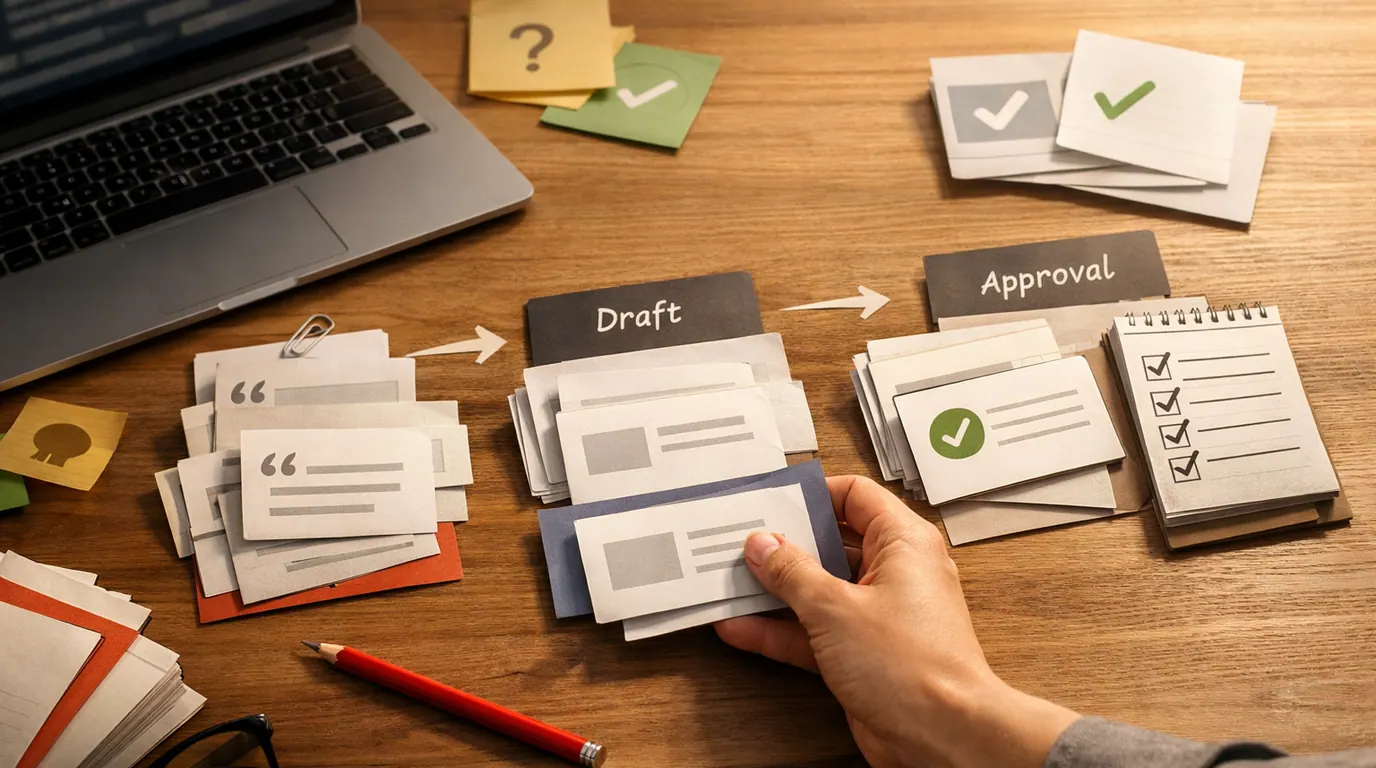
- Draft and critique separately. Use one prompt to draft and another prompt to review for facts, specificity, tone, claims, and channel fit.
- Save what worked. Turn useful prompts into a shared template with fields, examples, owner, and last review date.
Here is a compact ChatGPT prompts for marketing template you can adapt for almost any repeated task:
Act as [marketing role].
Marketing job: [strategy, brief, copy, content calendar, email, ad, landing page, analytics, critique]
Audience: [who the output is for]
Offer or topic: [what we are promoting or explaining]
Source material: [approved notes, quotes, data, product details, constraints]
Channel: [where this will be used]
Voice and style: [brand rules and examples]
Success criteria: [what a good output must do]
Avoid: [unsupported claims, generic phrases, risky topics, wrong audience, wrong tone]
Return format: [table, outline, draft, variants, checklist, recommendations]
Before finalizing: flag assumptions, missing proof, privacy concerns, and human-review points.
For visual campaigns, the same structure applies to creative briefs. If the bottleneck is image or design production rather than copy, our guide to AI image generators can help you think through composition, source assets, and review steps.
The Human Review Checklist
Before saving or publishing any output, run this ChatGPT prompts for marketing checklist. The review step matters because the model can make weak ideas sound polished.
- Audience fit: Does the copy speak to a real segment, or does it describe everyone?
- Offer clarity: Can the reader tell what is being offered, why it matters, and what to do next?
- Proof: Are claims supported by source material, customer evidence, product facts, or verified data?
- Specificity: Could the same sentence be used by a competitor with no edits? If yes, rewrite it.
- Channel behavior: Does the format fit the platform, search intent, inbox, ad unit, or landing page section?
- Brand voice: Does it sound like your company, or like a generic marketing template?
- Compliance and privacy: Are you exposing private data, regulated claims, sensitive customer details, or unsupported performance promises?
- Measurement: Is there a clear next action or test, and can you tell whether it worked?
What to Avoid With Marketing Prompts
ChatGPT is useful for draft work, but it does not automatically know your current market, customer research, legal limits, product roadmap, live pricing, or channel performance. It can also produce confident strategy language from thin inputs.
Works Well When
- Use ChatGPT when you have real source material and need structure, variants, critique, or a first draft.
- Use it when the output is easy for a marketer to inspect before anyone publishes or spends budget.
- Use it to compare angles, expose assumptions, summarize approved research, and speed up repetitive campaign work.
Watch Out For
- Do not use it as the only source for customer research, competitor intelligence, legal claims, medical claims, or financial promises.
- Do not paste private customer data, unreleased metrics, or sensitive campaign exports into an unapproved tool.
- Do not publish copy that has not been checked for facts, brand voice, platform fit, and whether the offer is actually differentiated.
One practical safeguard is to ask for a critique before asking for polish:
Review this marketing draft before improving it.
Audience: [audience]
Offer: [offer]
Channel: [channel]
Goal: [goal]
Draft: [paste draft]

Find the top 10 issues by priority.
Label each issue as one of:
- Unsupported claim
- Generic language
- Wrong audience
- Weak proof
- Confusing offer
- Channel mismatch
- Compliance or privacy risk
- Missing next action

Suggest a specific fix for each issue. Do not rewrite the full draft yet.
This keeps the model in reviewer mode. It also makes the human decision clearer: which problems matter, which suggestions are useful, and which claims need verification outside the chat.
Build a Small Team Prompt Library
If a prompt works twice, save it. Marketing teams get more value from a small, reviewed library than from hundreds of unsorted prompts in personal chats.
| Field | What to save | Why it matters |
|---|---|---|
| Job | The exact marketing task the prompt supports. | Prevents one prompt from becoming a vague all-purpose request. |
| Inputs | Required source material, examples, data, constraints, and brand rules. | Makes quality depend on real context, not model guesswork. |
| Output | The table, brief, draft, checklist, or critique format you expect. | Helps teammates compare results and reuse the prompt consistently. |
| Review | The human checks required before the output is used. | Keeps facts, privacy, claims, and brand standards visible. |
| Owner | The person responsible for maintaining the prompt. | Stops old prompts from becoming unofficial policy. |
Keep the library simple: one prompt per job, one owner, one review rule. Add examples of good outputs and bad outputs when possible. A good saved prompt should make a new teammate faster without hiding the judgment needed to use it well.
The Bottom Line
The best marketing prompts are not the most elaborate. They are the ones that turn a real marketing job into a clear brief, use approved source material, ask for options and tradeoffs, and make human review unavoidable.
Start with one repeated workflow this week: a content brief, campaign plan, email sequence, social post, landing page critique, or analytics readout. Fill in the template, run the prompt, critique the output, and save the version that actually helped. That is how ChatGPT prompts become a marketing system instead of another folder of clever examples.
Frequently asked questions
What should I include in a ChatGPT marketing prompt?
Include the audience, offer, channel, source material, brand voice, constraints, desired format, and review rule. A prompt like write a campaign makes ChatGPT guess; a compact creative brief gives it enough context to produce options you can judge and revise.
What are the best ChatGPT prompts for marketing?
The best prompts are tied to a specific job: audience research, positioning, campaign planning, content calendars, emails, ad copy, SEO briefs, social posts, and analytics summaries. They ask for tradeoffs, assumptions, and risks, not only polished copy.
Can ChatGPT build a marketing strategy?
ChatGPT can draft a strategy framework, organize assumptions, compare audience segments, and turn notes into a campaign plan. It should not be the final source of market truth. Verify customer evidence, budget assumptions, positioning, claims, and channel fit before execution.
How do I use ChatGPT for social media marketing?
Give ChatGPT the audience, platform, offer, content pillar, examples of your voice, and the action you want. Ask for several post angles, captions, hooks, and repurposing options, then delete generic lines and adjust anything that ignores the platform's real behavior.
Is it safe to paste customer data into ChatGPT for marketing?
Do not paste private customer data, unreleased financials, sensitive campaign exports, or regulated information into an unapproved AI tool. Use anonymized or aggregated data when possible and follow your company's privacy, legal, and vendor-review rules.
How do I make AI marketing copy sound less generic?
Provide real customer language, product proof, constraints, examples of copy you like, and phrases you never use. After the draft, ask ChatGPT to mark vague claims, replace filler with concrete examples, and explain what still needs a human decision.