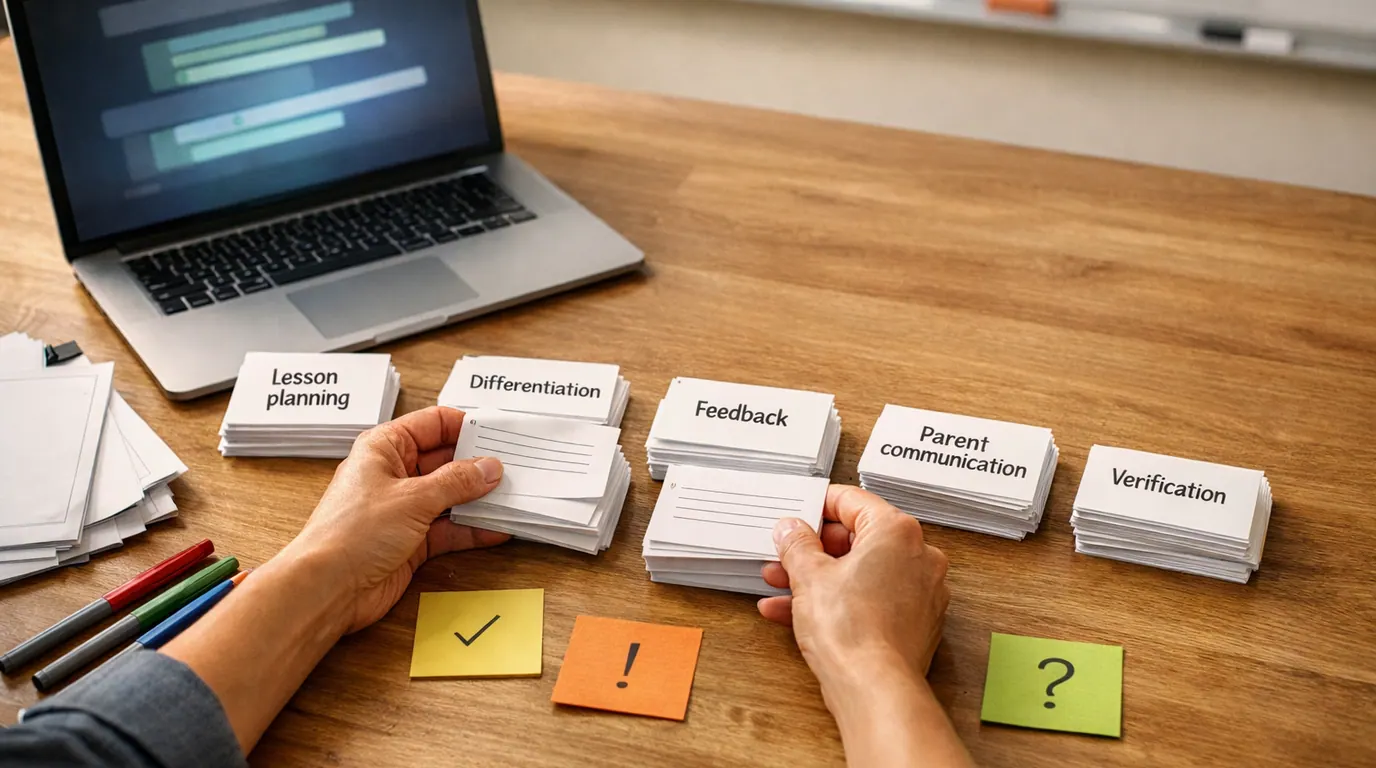
If you searched for “how to use ai for seo,” the useful answer is not “let AI write a blog post.” The useful answer is a repeatable way to use AI for keyword research, search intent, content briefs, internal links, technical cleanup, refreshes, and reporting without giving up human judgment.
AI is good at compressing messy inputs into a first pass: grouping keywords, spotting repeated questions, turning a crawl export into plain English, drafting metadata options, and comparing a page against a brief. It is weaker when asked to be the strategist, the source of truth, or the final publisher.
Treat this as a how to use AI for SEO guide for everyday work. The goal is not more AI content. The goal is better decisions, clearer pages, fewer missed gaps, and a review trail you can trust.
Pick keyword clustering, SERP review, briefs, refreshes, internal links, technical explanations, or reporting before changing your whole process.
Use Search Console exports, keyword data, page drafts, crawl reports, customer language, support tickets, and analytics notes.
People still own search intent, facts, examples, claims, brand voice, technical changes, and final publish decisions.
What AI Should Do in SEO
AI SEO is the practice of using AI tools to improve SEO research, planning, optimization, analysis, and review. It is not a separate replacement for search strategy. It is a faster way to do parts of traditional SEO that are data-heavy, repetitive, or hard to scan manually.
Google’s own Search guidance is a useful guardrail here. Its people-first content guidance emphasizes helpful, reliable content created for readers, and its guidance on generative AI content warns against scaled content that adds little value. The practical reading is simple: AI assistance is acceptable when it improves the work; thin automation is still thin automation.
Use AI for SEO when the output is reviewable:
- Research: expand keyword ideas, cluster topics, infer intent, and turn customer language into page angles.
- Planning: create briefs, compare outlines, identify missing questions, and map content to funnel or product goals.
- Optimization: draft title tags, meta descriptions, headings, FAQs, internal link suggestions, and image alt text options.
- Technical SEO: explain crawl findings, summarize log or audit exports, propose ticket wording, and create test checklists.
- Measurement: summarize Search Console changes, flag anomalies, group winners and losers, and suggest follow-up questions.
Do not use AI as the only source for facts, expert claims, statistics, legal or medical statements, product comparisons, author experience, or technical production changes. The model can prepare the next move, but a person has to decide whether that move is correct.
The AI SEO Workflow to Use First
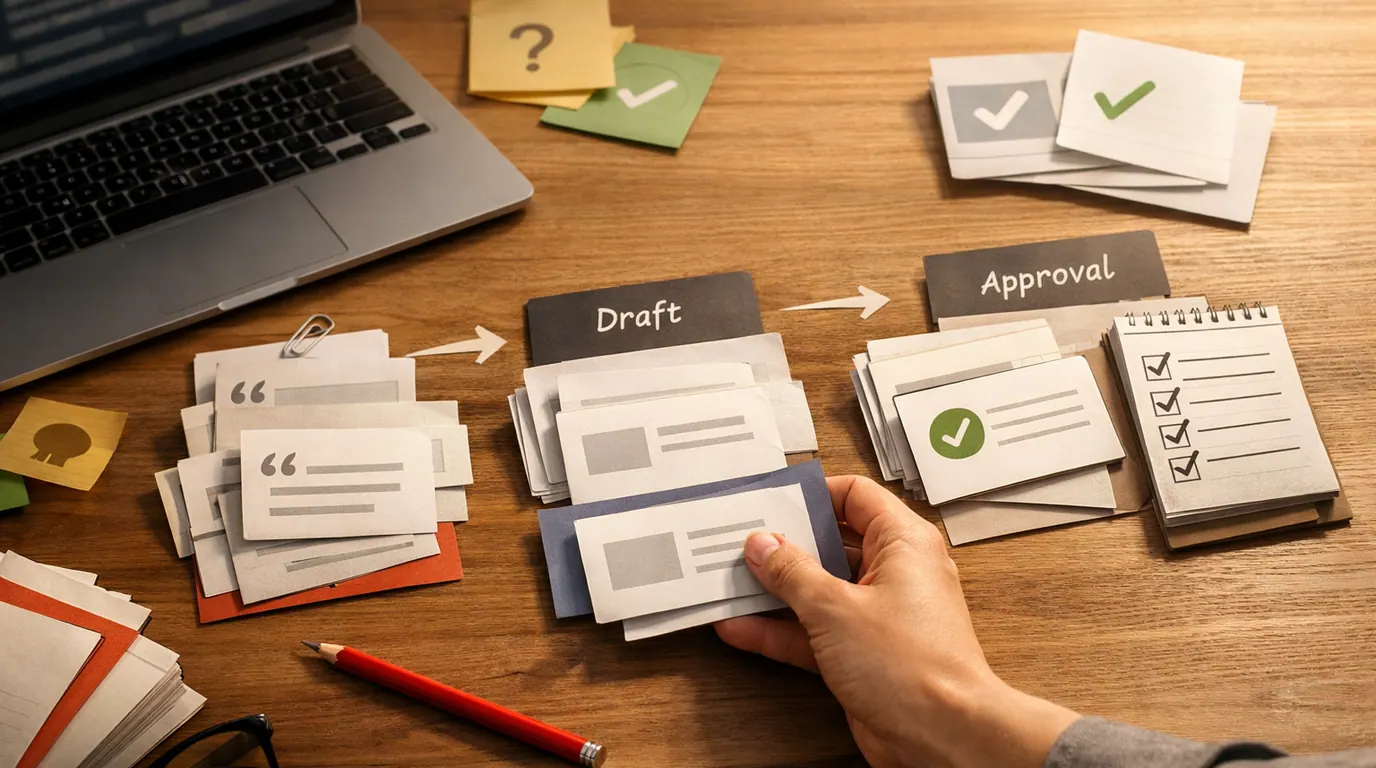
The safest AI SEO workflow is a loop of evidence, draft, review, and measurement, not a shortcut from prompt to publish.
Start with a real input, ask AI for a narrow output, then review that output against search intent and business reality. This is the practical how to use AI for SEO workflow most teams can adopt without creating a content quality problem.
| Workflow stage | How AI helps | Example request | Human review point |
|---|---|---|---|
| Keyword and intent mapping | Groups related keywords, labels likely intent, and separates informational, commercial, comparison, and support queries. | Cluster these keywords by shared intent and suggest which cluster deserves one page versus separate pages. | Check search volume, SERP overlap, business value, and whether the cluster would satisfy a real reader. |
| SERP and content gap review | Summarizes recurring angles, questions, formats, and missing subtopics across top-ranking pages or research notes. | Compare these competitor notes and list the repeated angles, weak spots, and questions our page should answer better. | Open the sources yourself and avoid copying their structure or claims without adding original value. |
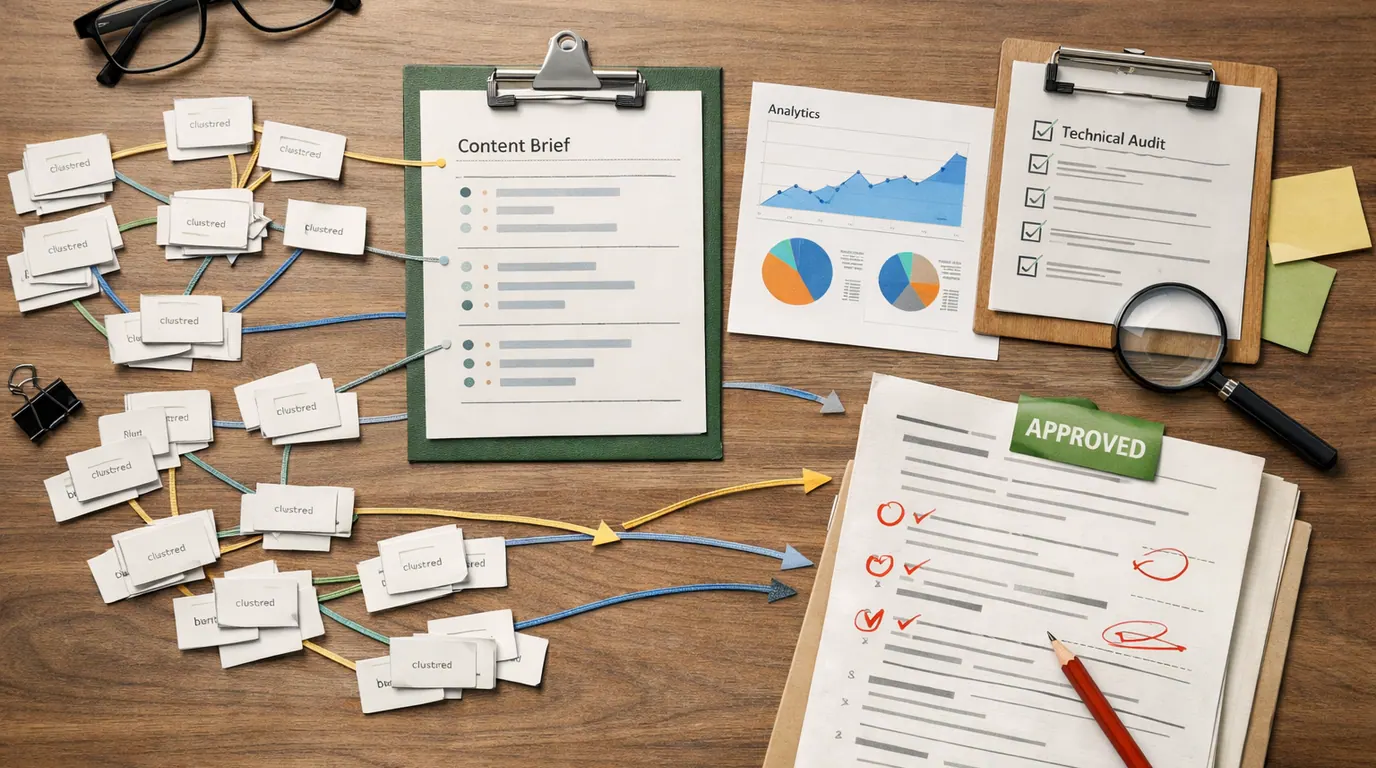
| Content brief creation | Turns keyword, audience, source, and product notes into a brief with intent, outline, examples, FAQs, links, and review criteria. | Create a content brief for this query using the source notes below. Include examples, cautions, and claims that need proof. | Approve the angle, evidence standard, internal links, expertise, and whether the page deserves to exist. |
| Draft support | Creates a first outline, section alternatives, title options, meta descriptions, and rewrite suggestions. | Draft three title tags and meta descriptions under the limits. Keep them accurate and avoid hype. | Choose or rewrite the final copy; verify facts, tone, originality, and promise accuracy. |
| On-page optimization | Checks headings, entity coverage, internal link opportunities, image alt text, FAQs, and whether each section answers the query. | Review this draft against the brief and flag missing intent, weak examples, unsupported claims, and internal link opportunities. | Make the final editorial call and remove any generic AI filler. |
| Technical SEO explanation | Translates crawl, indexing, schema, redirect, and performance issues into plain-language tickets and test steps. | Explain these crawl errors and group them by likely cause, priority, and owner. | A technical SEO or engineer verifies the diagnosis, tests fixes, and protects production systems. |
| Reporting and refreshes | Finds patterns in Search Console exports, traffic drops, ranking gains, stale pages, and cannibalization candidates. | Summarize this page performance export and flag unusual drops, rising queries, and refresh opportunities. | Validate calculations, seasonality, tracking changes, SERP changes, and whether the recommendation is worth acting on. |
If you are still learning how to use AI, this table is the right starting point because every row produces something a person can review. For prompt structure, use the task, context, criteria, format, and review pattern from our guide to writing better AI prompts.
Build a Strategy Around One SEO Bottleneck
A strong how to use AI for SEO strategy starts with one bottleneck, not a tool shopping list. People asking for the best how to use AI for SEO answer usually need a decision rule: buy or build around the stage where human time is most constrained and AI output is easiest to check.
Use this seven-step strategy:
- Name the workflow: keyword research, content refreshes, briefs, internal linking, technical audit review, metadata, schema drafts, or reporting.
- Define the input: keyword exports, SERP notes, existing URLs, Search Console data, crawl reports, customer questions, product notes, or source documents.
- Ask for one output: a cluster table, brief, gap list, rewrite options, ticket summary, checklist, or anomaly report.
- Set the review rule: decide who checks factual claims, search intent, examples, technical suggestions, private data, and final copy.
- Run a small pilot: test on five keywords, one page refresh, one crawl export, or one content brief before using it across a site.
- Track the cleanup cost: measure how much editing, fact-checking, source checking, and rework the AI output creates.
- Save the reusable pattern: keep the prompt, source requirements, examples, and review notes only if the workflow produces better decisions.
That last step matters. AI can make an SEO process feel faster while quietly moving the real work into cleanup. A prompt is worth saving only when it reduces ambiguity, not when it creates a polished draft that still needs to be rebuilt.
For research-heavy pages, pair this process with the source discipline in How to Use AI for Research. For operational handoffs such as content queues, approvals, and recurring reports, the same review logic appears in our AI workflow automation guide.
AI SEO Examples You Can Reuse
The most useful how to use AI for SEO examples are ordinary. They help you move from scattered SEO inputs to a reviewable next action.
| Everyday SEO job | Use AI for | Example output | Human review |
|---|---|---|---|
| New blog brief | Search intent, outline, missing questions, source needs, and internal link ideas | A one-page brief with audience, angle, H2s, examples, FAQs, and proof requirements | Check whether the angle adds anything beyond the current SERP and whether the writer has enough evidence. |
| Existing page refresh | Compare current queries, stale sections, missing examples, and new questions | A refresh plan that separates quick edits from deeper rewrites | Confirm traffic changes, date-sensitive claims, product changes, and whether the page still targets the right query. |
| Title and description testing | Generate accurate variants for different angles or page types | Ten title tag and meta description options with length notes | Remove clickbait, duplicated titles, vague benefits, and claims the page does not support. |
| Internal linking | Suggest links from related posts, glossary pages, product pages, or support content | A table of source page, target page, anchor idea, and reason | Use only real URLs, natural anchor text, and links that help the reader continue the task. |
| Technical audit triage | Group crawl errors, duplicate metadata, redirect chains, canonicals, or indexation findings | A prioritized ticket list with likely owner and test steps | Verify in a crawler, browser, server logs, CMS, and Search Console before assigning fixes. |
| Analytics anomaly review | Summarize unusual drops, gains, query shifts, and pages that need inspection | A list of pages to investigate with possible hypotheses | Check seasonality, tracking changes, algorithm updates, SERP features, and business events before concluding. |
| Content quality review | Flag thin sections, unsupported claims, weak examples, repetitive phrasing, and missing user outcomes | An editorial checklist for revision | Add expertise, examples, original observations, and source-backed claims rather than only rewriting sentences. |
For a concrete example, imagine an old article that ranks for several long-tail questions but has declining clicks. AI can group the rising and falling queries, suggest which sections may be stale, and draft a refresh brief. A human still needs to open the page, inspect the SERP, decide whether the intent changed, and add better examples or evidence.
Another example: a crawl export shows hundreds of duplicate title tags. AI can group duplicates by template, page type, or URL pattern and explain likely causes. It should not push fixes into your CMS. The SEO or engineering owner should inspect templates, confirm the rule, and test a small batch first.
Prompt Templates for SEO Work
Copy these prompts as starting points. Replace the bracketed sections with real data, and do not paste private analytics, customer data, unpublished strategy, or paid tool exports into an unapproved AI system.
Keyword clustering prompt
Act as an SEO strategist helping with keyword clustering.

Goal:
[business goal or page type]

Keywords:
[paste keyword list with volume, difficulty, current URL, or source if available]

Task:
Group the keywords by shared search intent. For each cluster, suggest whether it needs one page, a section inside a page, or a separate page.

Return a table with:
- Cluster name
- Keywords
- Likely intent
- Suggested page type
- Reader question
- Why the cluster belongs together
- What a human should verify in the SERP

Do not invent volume, rankings, or difficulty. If the data is missing, mark it as missing.
Content brief prompt
Act as a careful SEO content strategist.

Primary query:
[query]

Audience:
[reader, skill level, buying stage, or role]

Source notes:
[paste verified source notes, product notes, customer language, or competitor observations]

Existing internal links to consider:
[paste real URLs and short descriptions]

Create a content brief with:
- Search intent
- Recommended angle
- H2 outline
- Concrete examples to include
- Claims that need evidence
- Internal link opportunities
- FAQ candidates
- Human review checklist

Do not write the article yet. Focus on the brief and flag anything that needs verification.
Refresh prompt
Review this existing page for an SEO refresh.

Page goal:
[goal]

Current draft or section text:
[paste text]

Performance notes:
[paste Search Console, analytics, or rank notes if available]

Task:
Identify sections that are stale, thin, duplicated, unclear, or missing user intent. Suggest specific edits, but separate factual updates from style rewrites.

Return:
- Keep
- Update
- Add
- Remove
- Claims to verify
- Internal links to add
- Risks if we publish without review
Technical audit explanation prompt
Explain this technical SEO audit output in plain English.

Site context:
[CMS, page type, recent migrations, known constraints]

Audit output:
[paste crawl, indexation, schema, canonical, redirect, or performance findings]

Return a table with:
- Issue group
- Likely cause
- Example URLs or patterns
- Priority
- Owner
- Test steps
- What not to change until verified

Do not assume access to the site. Mark uncertainty and list what a human should check.
These prompts work because they ask AI to prepare a decision artifact, not to make the final decision. The same principle applies to marketing prompts, briefs, and campaign planning in our ChatGPT prompts for marketing guide.
Optimize for AI Search Without Chasing Myths
AI search optimization, answer engine optimization, and generative engine optimization are often discussed as if they require a separate secret playbook. Some tactics are useful, but the foundation is still search quality.
Google’s AI features guidance says the same foundational SEO best practices apply to AI Overviews and AI Mode, with no additional technical requirements beyond being eligible in Search. Its generative AI optimization guidance also emphasizes useful, non-commodity content, technical clarity, relevant media, and content that answers real user needs.
That means AI can help you prepare for AI search by making pages easier to understand:
- Answer the actual question early: state the conclusion, then support it with examples, process, and caveats.
- Use clear structure: descriptive headings, short sections, tables, lists, FAQs, image alt text, and internal links help readers and systems parse the page.
- Add original value: include examples, decision rules, product knowledge, customer questions, firsthand observations, or expert review that a generic summary would miss.
- Keep technical basics healthy: crawlable pages, indexable content, mobile usability, canonical clarity, matching structured data, and visible text still matter.
- Be careful with AI SEO tools: Google’s third-party SEO tools guidance is a useful reminder to question claims about guaranteed rankings or special AI visibility hacks.
Use AI for SEO to make this work more consistent. Ask it to find vague sections, turn a long answer into a direct one, suggest where examples are missing, or check whether your structured data matches visible page content. Then review the result like an editor, not like an operator approving a machine’s final answer.
What to Avoid When You Use AI for SEO
AI creates SEO risk when it makes low-quality work easier to scale. The danger is not only factual error. It is publishing pages that look complete but add no experience, evidence, or decision value.
Works Well When
- Use AI to organize messy keyword data, SERP notes, customer questions, and existing page drafts.
- Ask for multiple title, heading, brief, or metadata options before choosing the final version.
- Use AI to flag unsupported claims, missing examples, thin sections, and duplicate intent.
- Ask AI to explain technical audit output before creating tickets or discussing fixes with engineering.
- Save prompts only when they create a repeatable review artifact that improves the work.
Watch Out For
- Do not publish AI-generated articles that only summarize the current SERP in different words.
- Do not invent statistics, sources, author experience, product results, or customer proof.
- Do not stuff keywords, entities, FAQs, schema, or internal links just because a tool suggested them.
- Do not paste private customer data, unreleased analytics, paid exports, or confidential strategy into unapproved tools.
- Do not let AI make live technical changes, bulk metadata edits, redirects, canonicals, or noindex decisions without human approval.
The biggest warning sign is a page that sounds optimized but cannot answer why it should exist. If the article has no original examples, no useful decision criteria, no evidence trail, and no clear next action, AI has made the page smoother without making it better.
The Human Review Checklist
Use this as a how to use AI for SEO checklist before publishing, refreshing, or scaling an AI-assisted workflow.
- Intent: Does the page answer the real search task, not only the literal keyword?
- Evidence: Are facts, statistics, dates, quotes, product claims, and examples verified against reliable sources?
- Original value: Does the page add examples, judgment, process, or experience that a generic AI summary would not provide?
- Structure: Are the title, description, intro, headings, tables, images, FAQs, and internal links useful to a reader?
- Technical basics: Is the page crawlable, indexable, canonicalized correctly, fast enough, mobile-friendly, and internally linked?
- Safety: Did the workflow avoid private data, unapproved tool uploads, unsupported claims, and automated production changes?
- Measurement: Is there a plan to check Search Console, rankings, engagement, conversions, or manual review feedback after publishing?
This checklist is also the simplest answer to how to use AI for SEO responsibly: use AI to reduce the cost of preparing and reviewing the work, then use human expertise to decide what deserves to go live.
The Bottom Line
The best way to use AI for SEO is to make it a fast assistant inside a disciplined workflow. Give it real inputs, ask for a narrow output, review the result, and measure whether the page or process improved.
AI can help with keyword research, briefs, content refreshes, metadata, internal links, technical explanations, and reporting. It should not replace source verification, reader empathy, technical ownership, brand judgment, or the final decision to publish.
Start with one page or one recurring SEO task this week. If AI produces a better brief, a clearer checklist, or a faster review without adding hidden cleanup, save the workflow. If it produces generic content that still needs a full rebuild, narrow the task and raise the human review bar.
Frequently asked questions
Can AI write SEO content for me?
AI can draft outlines, briefs, summaries, title options, and rough copy, but it should not be the final source of expertise. The safer path is to give it verified inputs, require citations or source notes where needed, then have a human add judgment, examples, accuracy checks, and brand voice before publishing.
What is the safest way to use AI for SEO?
The safest first use is a reviewable task: clustering keywords, summarizing search intent, building a content brief, finding missing subtopics, explaining technical audit output, or flagging analytics anomalies. Avoid letting AI publish, redirect, edit metadata at scale, or change indexed pages without approval.
Does AI SEO replace keyword research?
No. AI can speed up keyword expansion, clustering, intent labeling, and question discovery, but it still needs real keyword data from Search Console, rank trackers, SEO platforms, customer language, or internal site search. Use AI to organize evidence, then validate demand, difficulty, and business fit yourself.
How can AI help with technical SEO?
AI is useful for explaining crawl errors, generating hypotheses from log files or audit exports, drafting schema examples, summarizing redirect issues, and turning technical findings into tickets. A technical owner should still verify the diagnosis, test fixes, inspect rendered pages, and protect production systems.
Can AI help my pages appear in AI Overviews or AI search results?
AI can help you make content clearer, more complete, and easier to extract, but there is no separate shortcut for AI Overviews. Google says foundational SEO still matters: indexable pages, crawlable links, useful content, visible text, accurate structured data, and high-quality supporting media where relevant.
What should I check before publishing AI-assisted SEO content?
Check search intent, factual accuracy, original insight, source support, internal links, metadata, heading structure, examples, image alt text, duplication risk, privacy, and whether a real reader can act on the page. If the article could have been produced from any generic SERP summary, it needs more human work.