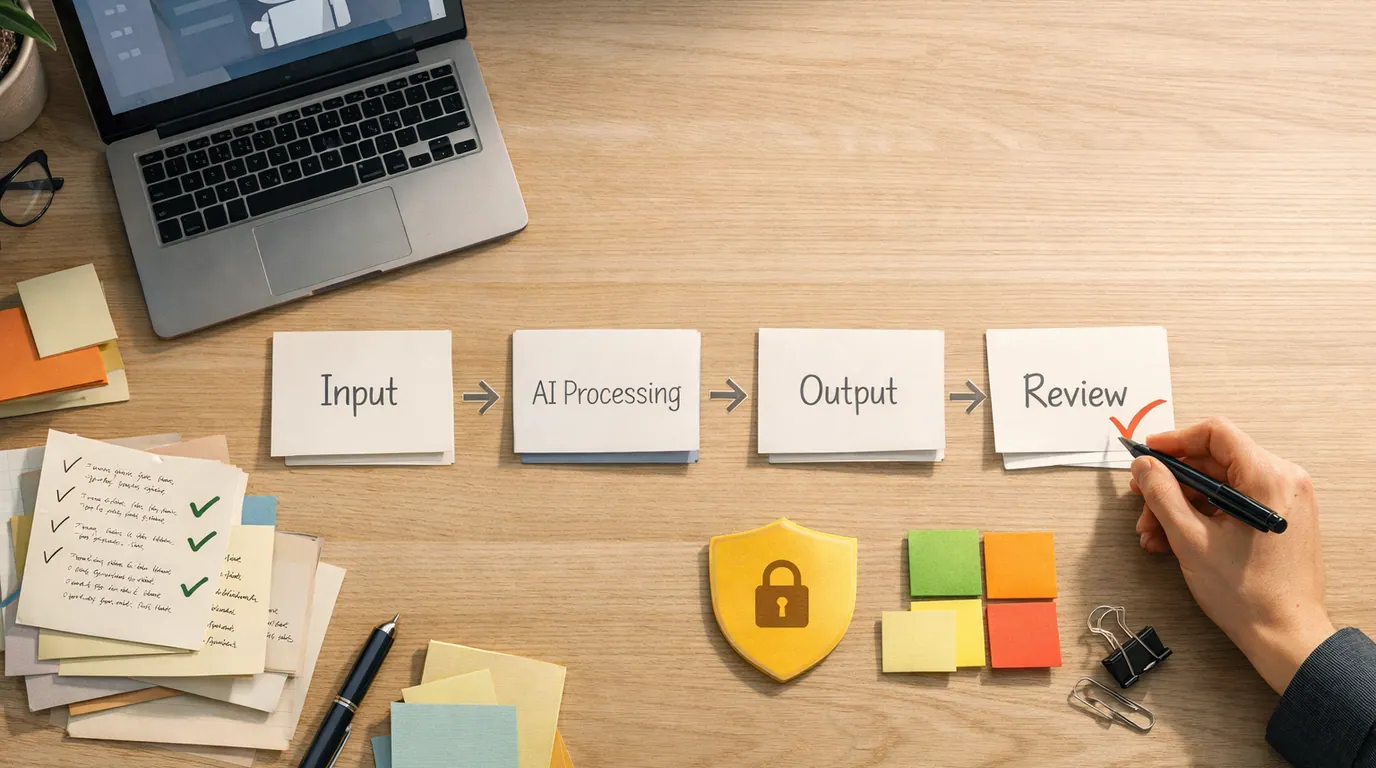
If you searched for “ai bias,” the useful answer is not just a definition. AI bias is what happens when an AI system repeatedly produces skewed, unfair, or incomplete results because of the data it learned from, the way it was designed, the way people use it, or the context where it is deployed.
Bias is not new, and it is not unique to AI. The difference is scale. A biased spreadsheet, recruiter, teacher, or loan officer can harm people one case at a time. A biased AI workflow can apply the same pattern across thousands or millions of decisions before anyone notices.
This AI bias guide gives you the plain answer, concrete examples, a practical review workflow, and a reusable checklist for deciding when a system needs stronger testing or human oversight.
AI bias is a repeatable pattern that unfairly favors, excludes, stereotypes, or misjudges people or outcomes.
The higher the consequence for a person, the more testing, explanation, review, and appeal the workflow needs.
Someone must be able to inspect, challenge, revise, or stop the system when unfair patterns appear.
AI Bias Explained: The Plain Answer
AI bias explained in one sentence: an AI system has bias when its outputs systematically lean in a direction that is inaccurate, incomplete, unfair, or harmful for the task.
IBM describes AI bias as biased results caused by human biases in training data or algorithms. NIST adds an important nuance: bias is not always negative, but AI can increase the speed and scale of harmful bias. Both points matter. The practical goal is not to prove a model is perfectly neutral; it is to make unfair patterns visible early enough that people can correct the workflow before it harms someone.
Bias can enter before the model exists. Historical hiring data may reflect who was previously given opportunity. Medical notes may reflect who received better care. Web text may overrepresent dominant languages, countries, and social groups. Labels may encode the judgment of reviewers who did not share the same standards.
Bias can also enter after launch. A tool trained for one country, classroom, language, or customer base may be used somewhere else. A manager may overtrust a score. A chatbot may be prompted in a way that reinforces a stereotype. Human choices and AI outputs can reinforce each other.
For the broader mechanics behind models, see our plain-English guide to how AI works. For systems that generate text, images, code, and summaries, our generative AI explained article covers why fluent output still needs review.
Everyday AI Bias Examples to Watch For
The clearest AI bias examples are ordinary workflows where a system looks neutral because it uses data, math, or automation. The risk is that the system may reproduce the unfair history inside the data while presenting the result as objective.
| Use case | How bias can show up | Everyday example | Review point |
|---|---|---|---|
| Hiring | Past hiring patterns become signals for future candidates. | A resume screener learns that previous successful candidates came from a narrow set of schools, employers, names, or career paths. | Test outcomes by job-relevant criteria and demographic groups where lawful, then require recruiters to review borderline and rejected cases. |
| Credit and insurance | Proxy variables stand in for protected or sensitive traits. | A lending model uses ZIP code, employment history, device signals, or shopping behavior in ways that disadvantage groups already underserved. | Check whether the model can explain the decision, whether variables are justified, and whether people can appeal. |
| Education | Language and access differences are mistaken for ability or misconduct. | An AI detector flags writing from non-native English speakers more often, or a tutoring tool assumes one cultural reference is universal. | Review accusations, grading support, and learning recommendations before they affect a student's record. |
| Healthcare | Data gaps turn into different quality of care. | A summary or triage tool trained on incomplete records gives less detailed explanations for some patients or frames similar needs differently. | Clinicians should inspect source notes, missing context, and patient impact before acting. |
| Policing and security | Historical enforcement patterns become future risk signals. | A surveillance or risk tool sends more attention to places or groups already over-policed. | Require legal review, bias testing, transparency, and strong limits before deployment. |
| Generative AI | The model reflects stereotypes in text, images, or advice. | An image prompt for a leader, nurse, engineer, or family produces narrow gender, race, age, or disability patterns. | Ask for diverse alternatives, inspect defaults, and avoid using generated stereotypes in customer or public work. |
Chapman University’s overview of bias in AI highlights confirmation bias and measurement bias as two common patterns. SNHU’s explainer is useful because it shows how everyday outputs can lead to downstream effects such as credit, insurance, and mortgage outcomes. The lesson is simple: bias often matters most when an output becomes an input to the next decision.
If your search looked like “best AI bias,” treat the best answer as the one that helps you find the highest-risk pattern first. The most urgent bias is where sensitive data, weak evidence, automation, and real-world consequences meet.
The AI Bias Workflow: Find, Test, and Review
An AI bias workflow should be concrete enough for a team meeting, not just an ethics statement. Use it before you adopt a vendor tool, build an internal model, deploy a chatbot, or rely on generated output for decisions about people.
- Name the decision. Write the exact output: ranking applicants, summarizing support tickets, flagging fraud, scoring risk, drafting feedback, recommending care, or generating advice.
- Name who can be affected. Identify the groups, languages, regions, roles, customers, students, patients, applicants, or communities that might receive different treatment.
- Trace the data path. Ask where the data came from, who is missing, who labeled it, what history it reflects, and whether sensitive proxies are present.
- Compare similar cases. Change only one relevant attribute at a time where appropriate, then check whether the output changes for reasons the team can justify.
- Inspect the failure mode. Separate harmless inconvenience from serious harm. A biased product recommendation is not the same as a biased hiring, health, school, or credit decision.
- Add human review and appeal. Decide who can override the model, what evidence they need, and how affected people can challenge the result.
- Monitor after launch. Track complaints, overrides, false positives, false negatives, group-level differences, drift, and new use cases that were not part of the original test.
The workflow works because it treats bias as an operational risk. You are not asking whether the AI system is good or bad in the abstract. You are asking whether this model, with this data, in this setting, for this decision, can be trusted with this level of consequence.
For research-heavy reviews, the source discipline in our guide to using AI for research applies here too: keep evidence visible, separate claims from interpretation, and do not let a fluent summary replace verification.
Build an AI Bias Strategy Before You Scale
An AI bias strategy should start with consequence, not technology. A low-risk brainstorming assistant needs lighter controls than a system that influences hiring, lending, policing, education, benefits, healthcare, or access to services.
Use three lanes:
| Risk lane | Examples | Minimum bias control | When to escalate |
|---|---|---|---|
| Low consequence | Brainstorming, rewriting public copy, summarizing non-sensitive notes, generating practice examples. | User review, clear caveats, and no sensitive decision-making. | Escalate if the output will be published, personalized, or used as evidence. |
| Moderate consequence | Customer support suggestions, internal knowledge search, marketing segmentation, training recommendations, policy drafts. | Documented data boundaries, sample testing, owner review, and monitoring for complaints. | Escalate if the output affects access, price, ranking, discipline, or eligibility. |
| High consequence | Hiring, credit, insurance, education records, healthcare triage, fraud flags, law enforcement, housing, benefits, or worker management. | Fairness testing, domain experts, legal or compliance review, explainability, audit logs, human approval, and appeal path. | Pause rollout if the team cannot explain, test, override, or monitor outcomes. |
| Unknown consequence | A general AI tool connected to private files, customer records, HR data, or business systems without a defined job. | Define the job before deployment. Do not rely on broad tool permission as a governance plan. | Escalate immediately if sensitive data or consequential outputs are involved. |
This is also where AI bias use cases should be separated from general productivity use. A chatbot drafting a public FAQ is one use case. A chatbot answering an employee’s leave, benefits, or accommodation question is another. A model summarizing resumes is different from a model ranking candidates. Similar interfaces can create very different fairness risks.
If your team is applying AI in recruiting or people operations, the playbooks on AI for HR and AI for recruitment are useful companion reads. They show where AI should prepare evidence while humans remain accountable for decisions that affect work, pay, and opportunity.
Works Well When
- The task has a clear decision owner, documented criteria, and reviewable outputs.
- The team can test similar cases and explain why outputs changed.
- The workflow includes a way to correct errors before they affect people.
- The model is monitored after launch, not only approved once.
Watch Out For
- The system uses hidden scores for high-stakes decisions.
- The team cannot explain what data or variables drive the output.
- Users are expected to trust an automated result without appeal.
- The tool is being reused in a context it was never evaluated for.
Use This AI Bias Checklist
Use this AI bias checklist before shipping a workflow or trusting an AI-generated recommendation. It is intentionally practical. A team should be able to answer each item with evidence, not optimism.
- Decision clarity: What exact output does the system produce, and who acts on it?
- Human impact: Could the output affect opportunity, money, education, health, housing, safety, reputation, or rights?
- Data coverage: Which groups, languages, geographies, edge cases, and histories are missing or underrepresented?
- Proxy risk: Are variables such as location, school, device, income, work history, writing style, or behavior standing in for sensitive traits?
- Measurement quality: Are labels, ratings, outcomes, and success metrics fair, current, and relevant to the job?
- Comparable cases: Do similar cases receive similar treatment when irrelevant attributes change?
- Explanation: Can a user, reviewer, manager, or affected person understand the main reason for the output?
- Override path: Who can stop or change the outcome, and how is that override recorded?
- Appeal path: Can affected people challenge a result or provide missing context?
- Monitoring: What signals will show that bias is emerging after launch?
A checklist is not a guarantee. It is a forcing function. It makes the hidden assumptions visible before a model becomes part of normal operations.
AI Bias Template for a Quick Review
Use this AI bias template when you need a short review note for a pilot, vendor evaluation, model change, or internal workflow. Keep it attached to the decision record so later reviewers can see what was tested and what was left unresolved.
Workflow: [Name the AI use case and exact output.]
People affected: [List users, customers, employees, applicants, students, patients, or communities.]
Data risks: [Identify missing groups, historical bias, proxy variables, weak labels, and sensitive data.]
Bias tests: [Describe comparable-case tests, group-level checks, edge cases, prompt tests, or review samples.]
Human review: [Name who approves, overrides, escalates, and handles appeals.]
Launch decision: [Ship, limit, revise, pause, or reject, with the reason.]
Reusable AI bias review note
The template is deliberately short because bias review fails when it becomes a document nobody reads. For high-consequence systems, this note should point to deeper fairness testing, legal review, security review, data documentation, and ongoing monitoring.
Where AI Bias Gets Harder
AI bias gets harder when people want one universal fairness answer. In practice, fairness depends on the task. A school placement tool, fraud model, hiring screen, medical triage assistant, content recommender, and image generator do not share the same acceptable tradeoffs.
There are also real tensions:
- More personalization can improve relevance while increasing privacy and proxy-variable risk.
- Removing a sensitive attribute does not remove all related signals.
- A model can be accurate overall and still perform poorly for a smaller group.
- Human review helps, but human reviewers can bring their own bias.
- Automated guardrails can reduce offensive outputs while hiding the evidence needed to study unfairness.
MIT Sloan Teaching and Learning Technologies warns that generative AI can produce skewed or misleading content, including images and text that reinforce stereotypes. The University of Kansas Center for Teaching Excellence notes another everyday risk: AI systems trained on public online text may reflect dominant cultural and linguistic perspectives.
The right response is not panic or blind trust. It is disciplined use: smaller pilots, clearer data boundaries, better tests, visible review, and honest communication about limits. This matters especially when AI and privacy overlap. Our guide to AI privacy concerns covers the data side of that same governance problem.
The Bottom Line
AI bias is not just a technical bug, and it is not solved by saying a model is objective. It is a repeatable skew that can come from data, design, deployment, human behavior, or the feedback loop between all of them.
The practical way forward is to name the decision, identify who can be affected, test comparable cases, check data quality, keep human review visible, and monitor after launch. If the AI output can affect a person’s opportunity, safety, money, education, health, or rights, bias review is part of the job, not an optional ethics sidebar.
Frequently asked questions
What is AI bias in simple terms?
AI bias is a repeatable skew in an AI system's output. It can happen when training data, labels, model design, prompts, evaluation, or deployment context reflects unfair patterns. The result may privilege one group or viewpoint while disadvantaging another, even when the system sounds objective.
Is all AI bias harmful?
No. Bias can simply mean a model has a tendency, preference, or assumption because it was optimized for a task. It becomes harmful when that tendency creates unfair treatment, hides important context, reinforces stereotypes, or affects opportunities such as hiring, credit, education, health, or safety.
What are common causes of AI bias?
Common causes include unrepresentative data, historical discrimination in the data, bad labels, proxy variables, narrow testing, weak feedback loops, unclear goals, and automation without review. Bias can also appear when people use the model in a context it was not designed or evaluated for.
How can I spot AI bias in everyday tools?
Look for repeated differences by group, language, location, age, gender, disability, income, or other relevant context. Compare similar cases, ask what data the tool used, test edge cases, inspect explanations where available, and keep a human reviewer for outputs that could affect a real person.
Can AI bias be completely removed?
Not usually. Teams can reduce harmful bias, document tradeoffs, improve data, test fairness, and add oversight, but complete neutrality is not a realistic promise. The responsible goal is to define fairness for the use case, measure known risks, correct what you find, and monitor after launch.
Who is responsible for AI bias?
Responsibility is shared among product leaders, data teams, vendors, legal and compliance teams, domain experts, and the people who deploy the system. A model cannot own the consequences. Someone needs authority to stop, revise, or override AI use when outputs are unfair or unsafe.