If you searched for “how to use ai for studying,” the useful answer is not “ask AI to summarize everything.” That can save time, but it can also remove the exact friction that helps you learn.
AI is most useful when it makes studying more active: turning notes into questions, forcing you to explain ideas back, exposing weak spots, creating targeted practice, and helping you plan the next session. It is least useful when it becomes the person reading, solving, writing, or remembering for you.
Treat this how to use AI for studying guide as a repeatable study system. Start with the rules for your class, give the tool only approved material, ask for reviewable outputs, and finish every session with your own recall.
Use AI to create questions, hints, mistake reviews, and study plans rather than finished answers.
If you can explain the idea without the tool afterward, the AI helped. If not, it mostly produced content.
Check course rules, source accuracy, and sensitive data boundaries before uploading class materials.
Start With the Rule: Practice, Do Not Delegate
The best how to use AI for studying advice is simple: use the model to make your practice sharper, not to remove the practice. A chatbot can explain a concept, create quiz questions, simplify a dense paragraph, or help you organize a week of review. It should not become the source of your final understanding.
Stanford’s student-facing AI learning guidance makes the same practical distinction: before using AI, check your instructor’s policy and ask whether the tool is helping your learning or replacing the work of engaging with the material. That is the right test for most students.
Learning how to use AI starts with boundaries. Ask three questions before each session:
- Am I allowed to use AI here? Course policies vary by assignment, even inside the same school.
- What work must stay mine? Reading, reasoning, solving, drafting, citing, and exam practice usually need human effort.
- How will I verify the output? Check the original source, answer key, rubric, textbook, lecture notes, or instructor guidance.
The strongest AI study session starts after the model answers: you close the tab, recall the idea, solve a new version, and check what broke.
The Five-Step AI Study Workflow
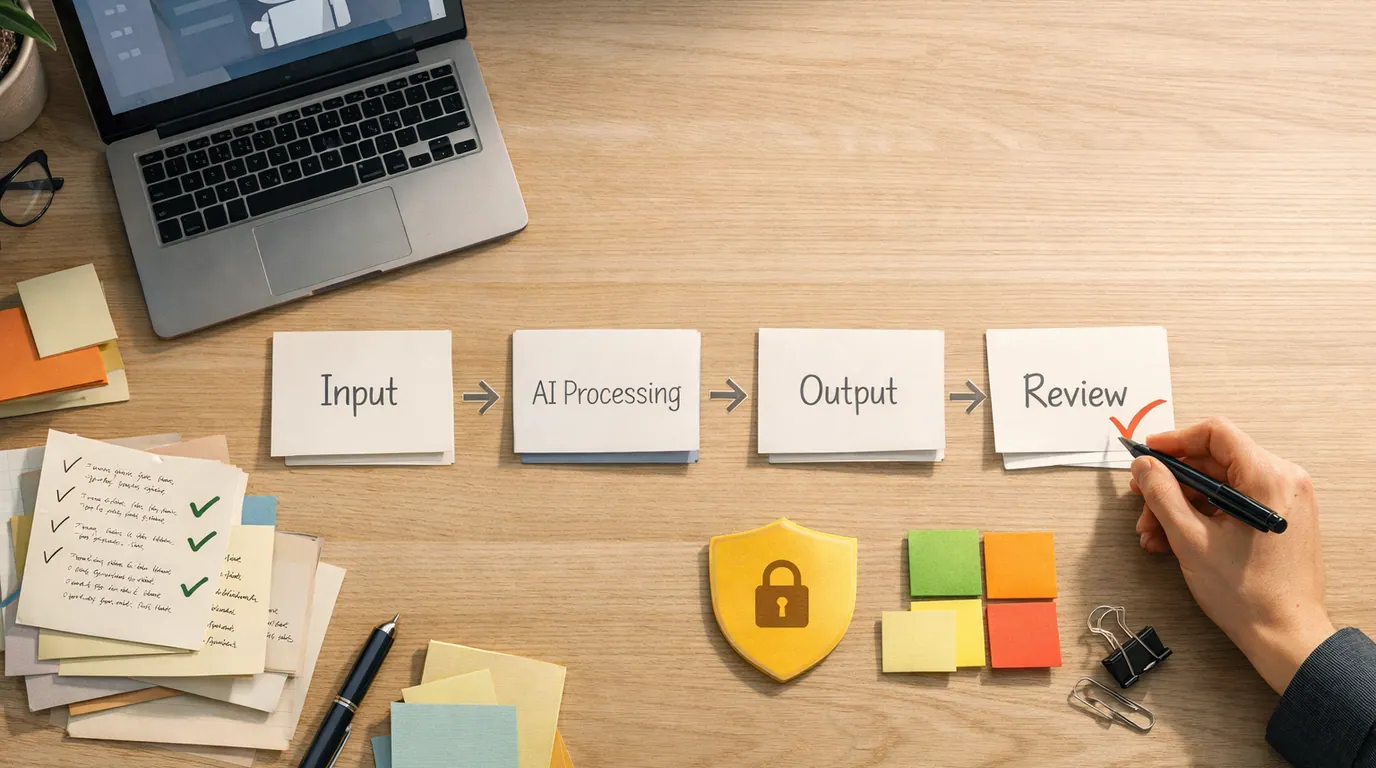
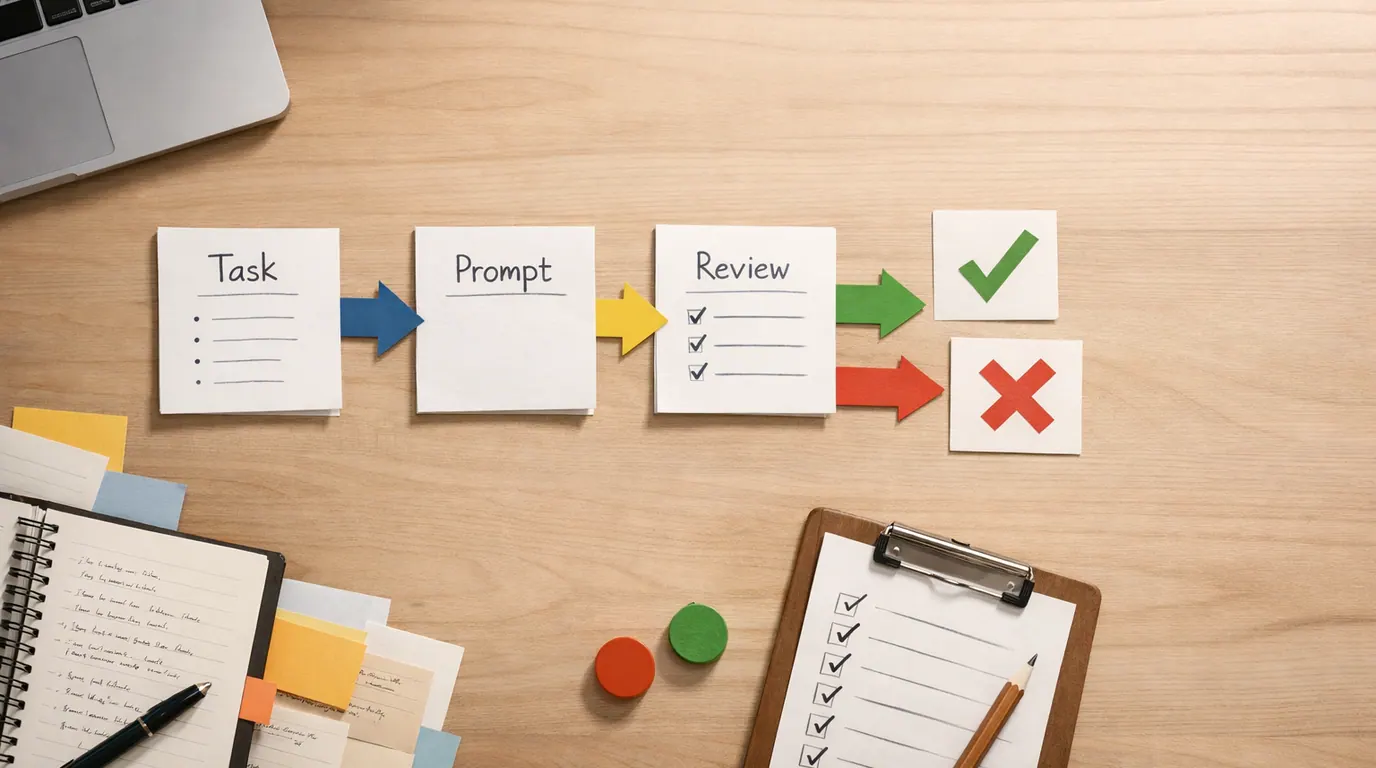
This how to use AI for studying workflow works for most subjects because it turns AI into a loop: prepare, quiz, explain, correct, and schedule. It is deliberately small enough to run after a lecture or before an exam block.
- Bring the right source. Use your lecture notes, slides, textbook excerpt, rubric, or problem set if your course rules allow it. Do not ask the model to guess what your class emphasized.
- Ask for active recall. Request questions before summaries. Mix definitions, applications, comparisons, and “explain why” prompts.
- Answer before seeing help. Write your response from memory. If you are stuck, ask for a hint instead of the answer.
- Review mistakes with evidence. Ask the model to explain the gap and point back to the source material you provided. Then verify against the original notes.
- Schedule the next review. Turn missed questions into a short plan: what to review today, tomorrow, and later in the week.
| Study step | AI prompt to use | Human check |
|---|---|---|
| After class | Turn these notes into 10 quiz questions: 4 recall, 3 application, 3 compare-and-explain. Do not show answers until I try. | Confirm the questions match what the instructor covered. |
| During practice | Give me one hint, not the answer. After I answer, explain whether my reasoning is correct. | Do the reasoning yourself before reading the explanation. |
| After a mistake | Explain the misconception behind my answer and give me a similar problem to solve. | Check the correction against the textbook, lecture, or answer key. |
| Before an exam | Build a 45-minute study session from my weak topics: review, quiz, correction, and final recall. | Spend more time solving and recalling than generating new materials. |
| After writing | Review my draft against this rubric. Identify unclear claims and missing evidence without rewriting the essay for me. | Keep the thesis, evidence, wording, and final judgment under your control. |
For a deeper prompt pattern, use the task, context, criteria, format, and review structure in our guide to writing better AI prompts. Study prompts need the same clarity, plus stronger rules around allowed material and human review.
Study Workflows to Try First
A practical use AI plan starts with one study job. Do not build a full tool stack before you know the bottleneck: understanding, memorizing, solving, writing, researching, planning, or staying focused.
| Study job | How AI can help | Example request | What you must still do |
|---|---|---|---|
| Understand a hard concept | Explain the idea at your level and give a concrete analogy. | Explain eigenvalues like I have finished the lecture but missed the intuition. Then give me two non-math examples. | Check the explanation against class notes and restate it in your own words. |
| Memorize terms | Generate flashcards or cloze questions from approved notes. | Create 20 flashcards from this biology lecture, but include common confusions on the back. | Review cards over several days and remove cards that are misleading. |
| Prepare for problem solving | Create similar practice problems with worked feedback after your attempt. | Give me one calculus problem like this, wait for my solution, then critique my steps. | Solve without looking, then redo missed steps by hand. |
| Study a reading | Create a preview, key questions, and a short quiz. | From this chapter excerpt, list the main claims, define key terms, and quiz me on the argument. | Read the original text and mark evidence the AI skipped. |
| Plan exam prep | Turn weak topics and deadlines into a review schedule. | I have 7 days, 5 chapters, and 2 weak areas. Build a daily plan with recall blocks and practice problems. | Follow the plan and update it based on actual quiz performance. |
| Get writing feedback | Critique your own outline or draft against a rubric. | Find the weakest claim in this paragraph and tell me what evidence would strengthen it. | Write and revise the final version yourself. |
| Support accessibility | Simplify, translate, read aloud, or reformat material when policy allows. | Rewrite this paragraph in simpler language and list the original terms I still need to know. | Return to the original material before citing or answering. |
If you need tool ideas, our AI tools for students shortlist compares source-grounded notebooks, general chatbots, research tools, flashcard systems, writing feedback, and accessibility tools. For this article, the more important choice is the workflow: the same tool can either train recall or tempt you into copying.
Copyable Study Prompts and Template
Use this how to use AI for studying template when you want a reliable study session from class material. Replace the bracketed parts with your course, topic, and source.
Act as a study coach, not as a homework solver.

Course and level: [class, grade or year, exam type]
Goal: Help me learn [topic] from the material below.
Allowed source material: Use only the notes, slides, reading excerpt, or problem I provide.

Create a study session with:
1. A 5-minute preview of the key ideas
2. 10 quiz questions, from easy to hard
3. No answers until I try each question
4. Hints before answers
5. A mistake log that names the concept I missed
6. A short review plan for the next session

Rules:
- Do not invent facts, citations, or instructor expectations.
- Flag anything uncertain.
- Ask me to explain ideas in my own words.
- Keep the final learning work with me.

Material:
[paste approved material]
Here are shorter prompts for common study situations:
Quiz me one question at a time on these notes. Wait for my answer before giving feedback. After each mistake, explain the misconception and give a similar question.I do not understand this paragraph. Explain it in plain language, then ask me to restate it. Correct my explanation only after I try.Review my essay outline against this rubric. Do not rewrite it. Identify the three weakest points, what evidence is missing, and what question I should answer next.Create a 30-minute study block for this topic: 5 minutes review, 15 minutes practice, 5 minutes mistake correction, 5 minutes final recall.The point of a template is not to make the AI sound clever. It is to stop the model from doing the wrong job. Good study prompts ask for practice, feedback, uncertainty, and review instead of finished schoolwork.
Everyday Examples of AI-Assisted Studying
These how to use AI for studying examples show the difference between useful support and hidden shortcut. In each case, the productive version keeps you responsible for recall, reasoning, and final work.
Biology lecture
Weak use: “Summarize photosynthesis for my exam.”
Better use: paste your allowed notes and ask for a misconception quiz. Answer without looking. When you miss a question about light-dependent reactions, ask for a one-paragraph explanation, then draw the process from memory and compare it with the lecture slide.
Math problem set
Weak use: “Solve question 12.”
Better use: attempt the problem first, then paste your work and ask, “Find the first wrong step. Give me a hint, not the full solution.” After correcting it, ask for one similar problem with different numbers so you prove the method transferred.
History reading
Weak use: “Give me the answer to the discussion question.”
Better use: ask AI to identify the author’s main claim, supporting evidence, and possible counterargument from the reading excerpt. Then write your own discussion answer with page references from the original text.
Essay revision
Weak use: “Write my introduction.”
Better use: write the rough introduction yourself, then ask for feedback on the thesis, evidence, and structure. If the AI suggests a rewrite, use it as critique, not as the final paragraph. Our broader guide to AI in education explains why the assignment goal matters more than the tool name.
Coding practice
Weak use: “Build the whole function.”
Better use: show the error message and the smallest relevant code block. Ask the model to explain the bug and give a similar practice bug. Run the code yourself, then write a one-sentence note explaining why the fix worked.
Checklist Before You Trust the Output
Use this how to use AI for studying checklist before you rely on an AI-generated summary, quiz, explanation, answer key, study plan, or feedback note.
- Policy: Is AI allowed for this class, assignment, exam prep, or draft?
- Source: Did the model use your approved material, or did it guess from general knowledge?
- Accuracy: Did you check names, dates, formulas, quotes, citations, definitions, and answer keys?
- Learning: Did the session make you retrieve, explain, solve, compare, or revise?
- Authorship: Are the final words, reasoning, evidence, and conclusions yours?
- Privacy: Did you avoid private records, classmates’ work, grades, medical details, or confidential files?
- Dependence: Can you do a similar task without the tool after practicing?
- Next action: Did you turn mistakes into a short review plan?
What to Avoid When Studying With AI
AI can make weak study habits look productive. A polished summary, perfect-looking answer, or long set of flashcards can create the feeling of progress before you have actually recalled anything.
Avoid these patterns:
- Passive summary loops: Reading AI summaries is not the same as remembering. Convert summaries into questions.
- Answer outsourcing: If the tool writes the final answer, essay, code, lab report, or discussion post, you may bypass the learning goal and violate the course policy.
- Fake citation confidence: General chatbots can invent sources, quotes, page numbers, and statistics. Open the original source before citing.
- Hidden privacy exposure: Uploading classmates’ work, student records, unpublished research, or sensitive personal details can create data risk. See our guide to AI privacy concerns for a broader checklist.
- Over-personalized shortcuts: A tool that always simplifies material may keep you away from the harder language your exam, lab, or workplace will actually require.
UC Denver’s student learning guidance highlights a useful pattern: AI-generated practice questions can support self-testing when students use them to deepen understanding, not to avoid readings or assignments. That distinction should shape every study workflow.
A One-Week Next-Action Strategy
A practical how to use AI for studying strategy is to run a small trial instead of changing every class at once. Pick one course, one weak topic, and one repeatable study loop.
- Day 1: Choose the boundary. Check the syllabus and decide which materials you may use with AI.
- Day 2: Build a question set. Turn one lecture or reading into 10 questions. Answer them without notes.
- Day 3: Make a mistake log. For every missed question, write the concept, why your answer was wrong, and the source to review.
- Day 4: Ask for targeted practice. Generate three similar problems or prompts for the weakest concept.
- Day 5: Teach it back. Explain the topic aloud or in writing without AI. Then compare your explanation to the source.
- Day 6: Review with spacing. Revisit the missed items and ask for a mixed quiz that includes old and new material.
- Day 7: Decide what stays. Keep the AI workflow only if it improved recall, reduced confusion, or helped you practice more consistently.
This is also the safest way to evaluate tools. A source-grounded notebook, general chatbot, flashcard app, or study platform is worth keeping only if it helps you practice the skill your course is measuring. Check current vendor pricing and school approval before paying for or uploading significant material.
The Bottom Line
How to use AI for studying comes down to one principle: make AI create better practice, then make yourself do the practice. Ask for quizzes, hints, explanations, mistake logs, schedules, and critique. Avoid letting the tool become your reader, writer, solver, or memory.
If you are unsure where to start, use the five-step workflow on one lecture today. Bring approved material, ask for questions, answer from memory, correct the gaps, and schedule the next review. That is where AI starts helping you study instead of quietly studying for you.
Frequently asked questions
Is it okay to use AI for studying?
Usually yes, if your class policy allows it and AI is supporting study rather than producing work you submit as your own. Use AI for explanations, practice questions, planning, feedback, and accessibility support. Check the syllabus first, and ask your instructor when the boundary is unclear.
What is the best way to use AI for studying?
The best use is active recall: give AI your approved notes or reading, ask it to quiz you, answer without looking, then ask it to explain what you missed. This turns AI from a shortcut into a practice partner. Summaries can help, but they should lead to testing and correction.
Can AI make study notes from my class materials?
Yes, many AI tools can summarize slides, readings, transcripts, or notes, but the summary should be a draft. Compare it with the original material, correct missing emphasis, and add your own examples. If you only read the AI summary, you may skip the work that builds understanding.
How do I avoid becoming dependent on AI?
Try the task first, then ask AI for hints, feedback, or extra practice. For hard problems, ask it to explain one step at a time instead of giving the final answer. After using AI, close the tool and write the idea, formula, argument, or process from memory.
Which AI tools are useful for students?
General chatbots can explain concepts and generate practice. Source-grounded tools such as NotebookLM-style notebooks are useful for studying your own materials. Flashcard and quiz apps can help with repetition. Pick by study job, not by hype, and check current pricing and school approval before uploading files.
What should I never put into an AI study tool?
Do not upload classmates' work, private student records, grades, medical details, unpublished research, passwords, confidential school files, or assignment content your instructor forbids using with AI. When in doubt, use public examples or anonymized notes and keep sensitive work inside school-approved systems.